Cannabis Packaging Saskatchewan: SLGA Guide
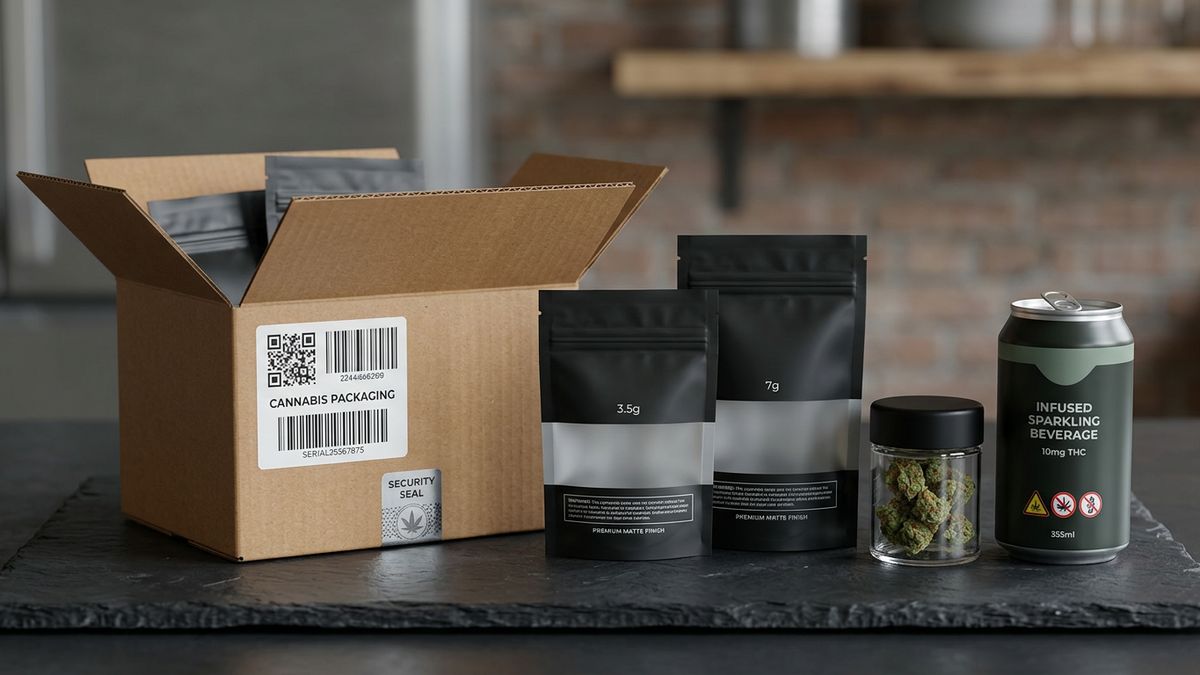
Cannabis packaging in Saskatchewan follows federal Health Canada rules, but the Saskatchewan Liquor and Gaming Authority (SLGA) controls who can sell into the province. Licensed producers must register with SLGA, ship direct to private permitted wholesalers or retailers, and every retail package must arrive sealed with a Saskatchewan excise stamp.
I've spent 22 years working in marketing and media connected to the cannabis industry. That started with Growing Exposed on YouTube (130,000+ subscribers and 12.5 million views), ran through bylines in High Times and Stoner Magazine, and today I own LG Digital Inc. Saskatchewan is the province that surprises people most. There's no government warehouse in the middle. Your product goes from your dock to a private business, and that changes how you should think about packaging and cases.
This guide covers only what's specific to Saskatchewan. For plain packaging, the THC warning, the standardized symbol and child-resistant container rules, start with our Health Canada packaging and labelling requirements hub and our cannabis packaging Canada pillar. Everything below sits on top of those.
Who Regulates Cannabis Packaging in Saskatchewan?
One body runs the provincial side: SLGA. It issues permits for the possession, sale, importation and delivery of recreational cannabis, and it licenses three kinds of business. Here's how SLGA's Cannabis Regulatory Policy Manual (Edition 2.3) breaks them down:
- Cannabis retail store permit: for businesses that sell cannabis for use off the premises. Retailers must run a physical storefront and can also sell online.
- Cannabis wholesale permit: for businesses that buy and distribute cannabis to retailers and other wholesalers. The warehouse must be physically located in Saskatchewan.
- Licensed producer (LP) registration: for federal licence holders authorized to package and sell finished cannabis products. This is the one most of our clients need.
Health Canada still licenses producers and owns the package and label rules. SLGA's manual says it plainly: packaging standards are federally regulated by the Cannabis Act and the Cannabis Regulations. SLGA doesn't write a second label standard. It controls who can sell, how product moves and what retailers are allowed to do with your package once it lands.
The legal framework
The rules come from The Cannabis Control (Saskatchewan) Act and The Cannabis Control (Saskatchewan) Regulations. Section 3-20 of the regulations says a registered supplier must follow any terms and conditions SLGA sets, including transportation standards, packaging and labelling standards, record-keeping and reporting, and cannabis recalls. So while SLGA leans on federal packaging law today, the regulation gives it room to add conditions. Check the current manual before every launch.
How Does Saskatchewan's Open Market Model Affect Cannabis Packaging?
Saskatchewan runs what SLGA calls an open market system for cannabis retailing and wholesaling. Compare that with Manitoba, Alberta, Ontario and BC, where a single Crown wholesaler buys from producers. In Saskatchewan, nobody buys on behalf of the province. According to SLGA's Wholesale and Licensed Producer Information page, only LPs registered with SLGA can sell into the Saskatchewan market, and registered LPs can ship directly from their existing warehouse facilities to a Saskatchewan permitted wholesaler or retailer.
That means you're negotiating with private buyers. A permitted wholesaler might take pallets. A single independent store might take one case. Retailers can even resell to other permitted retailers at wholesale, and the manual says there's no limit on the volume of those sales. Your product can change hands more than once before it reaches a shelf.
What that means for your shipper cases
Here's a detail that catches people off guard. SLGA's manual says SLGA does not establish standards for case markings. There's no provincial case spec to hit like there is at the AGLC warehouse in Alberta. That sounds easier, but it moves the burden onto you and your buyers. A private wholesaler will have its own receiving rules, and a small store may not have any.
My advice is to build one clean case standard and use it everywhere. Put the product name, size, units per case, lot number and a scannable barcode on two adjacent sides. Use a case count a small store can actually sell through. And pack for courier networks, because a lot of Saskatchewan product travels long distances to small towns. A thicker custom mylar bag with a strong zipper track survives a mixed courier box better than a thin stock bag.
What Does SLGA Require from Cannabis Packaging at Retail?
The packaging rules in Saskatchewan show up in the retail sections of the policy manual and the regulations. Four of them speak directly to your package.
Sold as packaged, with a Saskatchewan excise stamp
The manual says all cannabis products must be sold as packaged for final sale by federally licensed processors and sealed with Saskatchewan excise stamps, unless the product qualifies for the low-THC excise exemption. Health Canada notes that each province and territory has its own stamp, and Saskatchewan's is light green. A package with an Alberta or Manitoba stamp can't go on a Saskatchewan shelf. If you sell into several provinces, plan separate stamped inventory for each one and leave a flat, clear zone on the artwork where the stamp goes.
No modified or opened packages
The manual is direct: permittees are prohibited from modifying packages and from selling packages that have been opened. SLGA's own consumer factsheet repeats it for shoppers. Cannabis must be sold in a sealed package. If a seal fails in transit, that unit is done. Good tamper-evident seals and shrink bands should show tampering clearly but hold up under normal handling.
Resealing rules for opened product
Section 3-18 of the regulations covers what happens when a store opens a package, for example to fill a display. The store must immediately reseal it with a method that shows if it's opened again. That seal must list the date it was sealed, the quantity of cannabis or total package weight, and the name of the employee who opened it. Each later opening adds a new seal that carries all the earlier information. Opened product isn't for sale. It's a sample, and samples must be returned to the supplier or destroyed.
Display rules: no self-service, no handling
Customers in Saskatchewan can't touch or sample product. The manual bans self-service displays and requires cannabis in customer areas to be in a locked case or glassed-in counter that only staff can reach. Your retail unit lives behind glass, so finish and structure carry a lot of weight under plain-packaging rules. Our custom matte mylar bags finish guide covers how matte, soft-touch and gloss read under store lighting.
Two display details are worth knowing. Sample display containers may carry product information and brand preference information, as long as they comply with the Cannabis Act. And stores may display non-functional vape cartridges and batteries that customers can touch. If you sell vapes, a dummy cartridge in your standard vape cartridge box gives stores something to put in front of shoppers.
Standalone vs. integrated stores: where will your package sit?
Saskatchewan allows two retail formats, and the difference comes down to population. Under section 3-2 of the regulations, a cannabis store can't be integrated into another business unless it's in a municipality or reserve with fewer than 2,500 people.
- Standalone store: sells only cannabis, accessories and ancillary items. Nobody under 19 can enter.
- Integrated store: sells cannabis alongside other goods or services in a small community. The manual lists examples like a hotel, salon, spa or town office. Minors can be in some parts of the business, but not in cannabis storage or display areas.
Either way, the manual requires stores to keep cannabis and accessories out of sight of minors. For brands, the takeaway is that rural Saskatchewan has a real retail footprint. Those stores often order small, they're far from a city, and their staff may handle your case alone. A case that's easy to open, count and shelve wins repeat orders.
Online sales and delivery
Permitted retailers must run a storefront but can sell online for pick-up or delivery anywhere in Saskatchewan. Section 3-7 of the regulations requires that cannabis and accessories be delivered in packaging through which they aren't visible. The manual adds that each online sale can't exceed 30 grams of dried cannabis or the equivalent, and each 30 gram transaction must ship separately. Common carriers must check ID from anyone who appears to be 25 or younger. Your retail unit becomes the inner pack of a courier box, so durability matters here too.
Cannabis Packaging Saskatchewan vs. Manitoba, Alberta and Ontario: How Do They Compare?
Plenty of our clients sell across the Prairies and into Ontario. The federal label stays the same. The supply chain doesn't. Here's how cannabis packaging in Saskatchewan compares, based on SLGA sources, Health Canada's provincial retail page and the wholesaler material in our other province guides.
| Requirement | Saskatchewan | Manitoba | Alberta | Ontario |
|---|---|---|---|---|
| Wholesale model | Open market: private permitted wholesalers and retailers | MBLL is sole wholesaler | AGLC is sole wholesaler | Ontario Cannabis Store is sole wholesaler |
| Regulator | SLGA | LGCA | AGLC | AGCO |
| How product reaches stores | Registered LP ships direct to a permitted wholesaler or retailer | Supplier ships direct to retailers or via authorized distributors | Through the AGLC warehouse | Through the OCS warehouse |
| Producer registration | SLGA LP registration: $550 application plus $1,650 per year | MBLL supplier application | AGLC supplier listing | OCS supplier onboarding |
| Excise stamp colour | Light green | Grey | Orange | Yellow |
| Where legal to buy | Private in-person and online stores | Private in-person and online stores | Private in-person and online stores | Private in-person stores or government-run online store |
| Minimum age | 19 | 19 | 18 | 19 |
Sources: SLGA Cannabis Regulatory Policy Manual (Edition 2.3), SLGA wholesale and LP information page, The Cannabis Control (Saskatchewan) Regulations, Health Canada's authorized cannabis retailers page, and CropPak's Manitoba, Alberta and Ontario guides.
The short version: in Alberta and Ontario, the hard part is meeting one warehouse's spec. In Saskatchewan, it's selling to many private buyers who each set their own expectations. For the warehouse-side detail, see our Manitoba cannabis packaging guide, our Alberta cannabis packaging guide and our Ontario cannabis packaging guide.
How Do You Register with SLGA as a Licensed Producer?
SLGA's Licensed Producer Registration Application spells out the process. Only LPs with a federal processing licence to package and sell finished cannabis products can register, whether they're based in Saskatchewan or elsewhere in Canada. Registrations aren't site-specific, so affiliated licensed sites under a common parent need only one registration.
You'll submit:
- A copy of your Health Canada cannabis licence
- A copy of your complete CRA cannabis excise licence
- A Certificate of Incorporation or a Corporate Registry Profile Report from Information Services Corporation (ISC) Saskatchewan
- The applicant, business and contact sections, plus a signed certification and declaration
The fees, per the application and SLGA's fee schedule, are a $550 non-refundable application fee plus a $1,650 annual registration fee. Registrations are issued for three years, and SLGA recommends allowing at least 30 days for processing. Once registered, you must file monthly sales reports through the SLGA portal by the 15th of the following month.
The ECCnet step that ties back to packaging
This is the requirement I'd flag for every client. SLGA says LPs must share product records through GS1's ECCnet service at the consumer or base level, and registrations won't be issued until those records are shared. After registration, you're responsible for keeping ECCnet records current for every product you sell into Saskatchewan.
That puts your barcode and packaging data on the critical path. Your GTIN, net weight, format and dimensions have to match what's actually printed and packed. Lock your packaging spec before you build ECCnet records. Changing a bag size after the fact means updating records your buyers rely on. Our wholesale cannabis packaging buying guide walks through quotes, proofs and lead times so your packaging is final before registration.
Cannabis beverages have an extra step
If you sell drinks, there's a Saskatchewan-specific rule most guides skip. SLGA's application says cannabis beverage containers fall under the province's existing beverage container program. The importer must register each new container with SARCAN before it's sold, be licensed by the Ministry of Finance, and file monthly returns and remittances based on containers sold. Consumers return empty cannabis beverage containers to recycling depots like any other drink container. Settle your can or bottle format early, since each one needs registering.
Does Saskatchewan Have Its Own Child-Resistant Rules?
No. Saskatchewan doesn't add a separate child-resistant standard, but federal rules apply to every immediate container. Many CR mylar bags on the market are certified under the U.S. protocol in 16 CFR 1700.20, with the package classified under ASTM D3475. Keep a test report on file for each format you ship. A report for your 3.5 g pouch doesn't cover a pre-roll tube or a glass jar. Our child-resistant mylar bags ship with certification documents for that reason.
Because product in Saskatchewan can pass through a wholesaler, a retailer and a second retailer before a sale, CR features also need to survive repeated handling. Zippers that start to separate after a few rough trips are a real risk. That's why we keep our own person on the floor at our partner factory, making sure every order is made correctly and on time.
Cannabis Packaging Saskatchewan Checklist Before Your First Shipment
Here's the list I'd work through before a Saskatchewan launch:
- Health Canada processing licence that authorizes sale of finished products, plus a CRA cannabis excise licence.
- Business registered with ISC Saskatchewan.
- Product records shared through GS1 ECCnet at the consumer or base level, matching your printed packaging.
- SLGA LP registration approved ($550 application, $1,650 per year).
- Federal label and symbol compliance confirmed (see our standardized cannabis symbol guide).
- A flat, clear zone on the artwork for the light green Saskatchewan excise stamp, and separate stamped inventory for each province.
- Child-resistant certification on file for each packaging format.
- Tamper-evident features that show tampering clearly but don't fail in normal handling, since opened packages can't be sold.
- One consistent case standard with product name, units, lot and barcode, sized for small rural stores.
- SARCAN container registration and Ministry of Finance licensing if you sell beverages.
- A monthly reporting process ready for the 15th of each month.
If you want retail packaging and shipper cases built for Saskatchewan's open market, request a quote and tell us which provinces you're selling into. We'll spec bag sizes, barcode placement, finishes and case counts around how your product actually moves.
Frequently asked questions
Who regulates cannabis packaging in Saskatchewan?
Is there a government cannabis wholesaler in Saskatchewan?
How much does SLGA licensed producer registration cost?
Can Saskatchewan cannabis stores sell opened packages?
What is the legal age to buy cannabis in Saskatchewan?