Cannabis Packaging Alberta: AGLC Supplier Guide
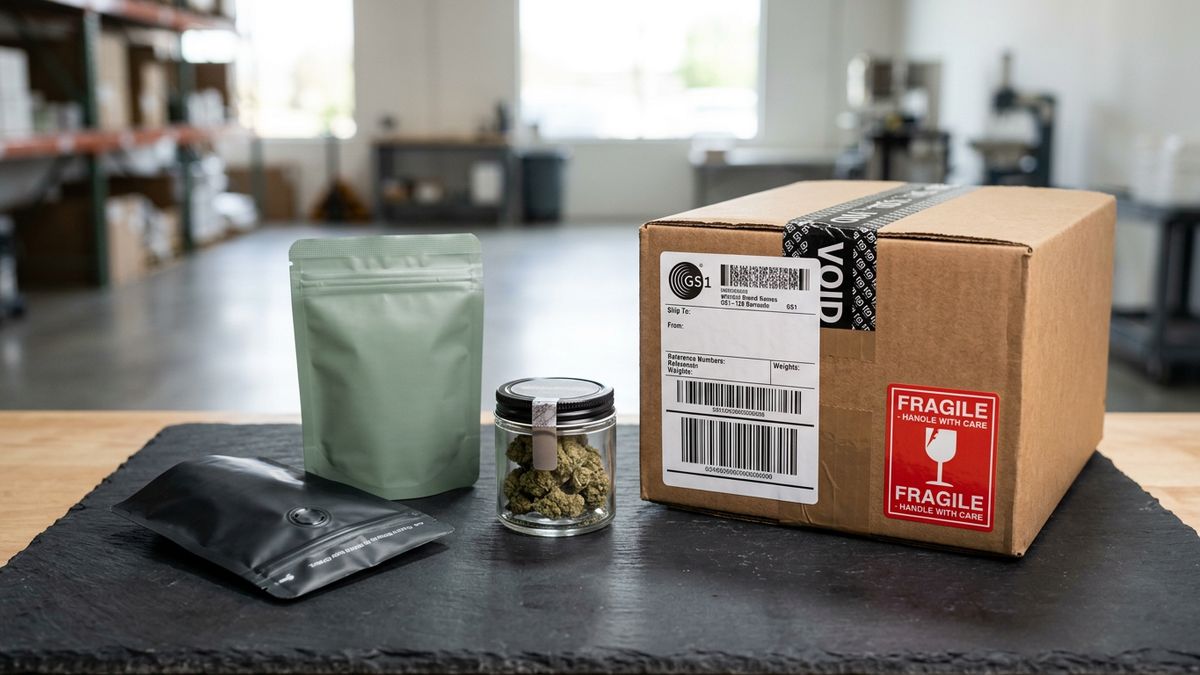
Cannabis packaging in Alberta has to clear two layers. Health Canada sets the federal package and label rules. Alberta Gaming, Liquor and Cannabis (AGLC), the province's sole cannabis wholesaler, adds its own supply chain specs: GS1-128 labels on two adjacent sides of every master case, no inner packs, one lot per case, a hard cap on case dimensions and a $1,000 penalty per non-compliance.
I've spent about 20 years working in marketing and media connected to the cannabis industry. That started with Growing Exposed on YouTube (130,000+ subscribers and 12.5 million views), ran through bylines in High Times and Stoner Magazine, and today I own LG Digital Inc. CropPak ships out of Abbotsford, BC, and Alberta is the next market over for a lot of our clients. The producers who struggle there almost never fail on the federal label. They fail at the warehouse dock over a case that's an inch too tall or a barcode that wraps around a corner.
This guide covers only what's specific to Alberta. For plain packaging, the THC warning, the standardized symbol and child-resistant container rules, start with our Health Canada packaging and labelling requirements hub and our cannabis packaging Canada pillar. Everything below sits on top of those.
Who Regulates Cannabis Packaging in Alberta?
Alberta is different from Ontario and BC because one agency does both jobs. According to the AGLC Cannabis Licensed Producer Operations Manual (Version 9.0, July 2025), AGLC has two roles under the Gaming, Liquor and Cannabis Act:
- Regulator: AGLC licenses and inspects private retail stores and their online sales, and it registers licensed producers (LPs) as cannabis representatives.
- Wholesaler: AGLC is the only source of recreational cannabis for private retailers in Alberta. It buys from federally licensed producers across Canada and resells to stores.
The physical warehouse isn't run by AGLC staff. Connect Logistics Services (CLS) is the warehouse AGLC designates to receive inventory and ship on its behalf. When your truck pulls up, it's CLS that scans your barcodes, checks your ASN and decides whether your load comes off the trailer.
Here's the practical split. AGLC QA approves your labels and packaging before the first purchase order. CLS enforces the case and shipping specs at the dock. Health Canada still owns the federal rules, and AGLC says plainly that following its manual doesn't replace compliance with the Cannabis Act or the Consumer Packaging and Labelling Act.
How Does Alberta's Retail Model Shape Your Packaging?
Alberta runs a fully private retail model. AGLC used to sell online through AlbertaCannabis.org, but per the AGLC's cannabis FAQ, amendments to the Gaming, Liquor and Cannabis Act on March 8, 2022 let licensed retailers sell online and deliver, and AGLC withdrew from online sales. The old government site now says Alberta has over 700 licensed cannabis retailers.
That's a lot of shelves. The numbers that matter, from the AGLC Retail Cannabis Store Handbook and the AGLC FAQ:
- Minimum age: 18, the lowest of any province. Minors can't enter a store, even with an adult.
- ID checks: staff must check government-issued photo ID for anyone who appears under 25.
- Purchase limit: 30 grams of dried cannabis or equivalent per transaction, in store or online.
- Store hours: any time between 9 a.m. and 2 a.m., unless a municipality sets shorter hours.
- Original packaging: cannabis must be sold in its original sealed packaging as received from AGLC, and labels can't be removed, altered or tampered with.
- Online sales: only retailers with an operating bricks-and-mortar store can get an online endorsement, and every order is capped at 30 grams.
The "original sealed packaging" rule is the one that matters to your packaging spec. Nobody downstream repacks your product, so your retail unit has to survive the CLS warehouse, a pallet ride to a store anywhere in the province and a locked showcase. Stores can use sensory display containers, but the handbook requires those to be transparent, secured to the counter, tamper-proof and no bigger than 500 ml. Your sealed unit is still what goes home with the customer.
One more packaging detail most people miss. Section 4.3.5 of the handbook requires Alberta retailers to offer child-proof lockable storage containers for sale. If you make accessories as well as cannabis products, that's a real category.
Cannabis Supplier Retail Stores
Since a July 2, 2025 AGLC bulletin, licensed producers can apply for a Cannabis Supplier Retail Store licence to sell cannabis produced at their facility directly to consumers from a store at that facility. It's Alberta's version of a farmgate store. The packaging doesn't get a pass: product still has to meet every federal requirement.
What Does AGLC Require Before Your First Purchase Order?
AGLC buys through supply contracts, not one-off orders. Once you're under contract, you register each product with the Product Master Template, and AGLC charges a $250 listing fee per SKU. The supply contract also deducts a 2% salvage/damage fee from each gross shipment.
For every new SKU, the LP manual says you must send AGLC QA:
- A PDF or picture of the unit label for each SKU, including all Health Canada required labelling
- A PDF or picture of the unit packaging for each packaging type
- A PDF or picture of the case label (new suppliers only)
- A PDF or picture of unit hardware, if applicable
- Child resistant certification for each packaging type
- Any changes to previously submitted documentation
- A shelf-life study, if available
Barcodes also go to CLS for approval before the first PO can be created. And if you change anything after approval, including labelling, packaging, branding or best before dates, AGLC QA has to re-approve it before you implement the change.
Item 5 is where your packaging supplier earns its keep. Federal rules define a child-resistant package by reference to recognized test standards, and many CR mylar bags on the market are certified under the U.S. protocol in 16 CFR 1700.20, with the package classified under ASTM D3475. AGLC wants a certificate for each packaging type, so a report for your 3.5 g bag won't cover a glass jar or a pre-roll tube. Our breakdown of child-resistant mylar bag certification and testing shows what a real report looks like.
Private label products
Alberta allows private label (store brand) cannabis, added to AGLC policy in May 2024. Here's the packaging catch: the handbook says strip labels or stickers aren't acceptable to identify private label products. If a retailer's name or logo goes on the package, it has to be printed into the packaging or primary label, not slapped on afterward. Plan your print run for that from day one.
What Are the AGLC Barcode and Label Rules for Cannabis Packaging in Alberta?
AGLC follows GS1 formats, with one twist that surprises producers coming from Ontario. The LP manual states the barcodes must be in GS1 format, but they don't need to be registered with GS1. The OCS, by contrast, requires suppliers to go through GS1 Canada.
Retail unit barcodes
- Accepted formats: GS1 DataBar Expanded, DataBar Stacked or GS1 DataMatrix (2D).
- QR codes: allowed only in addition to one of those three formats, and any content behind the QR code has to comply with AGLC and Health Canada rules.
- Data: (01) 14-digit GTIN, (13) packaged-on date in YYMMDD format, (10) lot number up to 20 characters.
- Human-readable text: packaged-on date and lot number, in a font no smaller than size 6.
- Curved containers: on an oil bottle, orient the barcode vertically so it sits as flat as possible. Barcodes on extreme curves are deemed non-compliant.
- Co-packs: need a unique master lot number on the outermost packaging, traceable to every immediate container inside.
Lot numbers trip people up. AGLC says special characters in the lot number aren't permitted, lots must be unique to each production lot, and a lot number can't be reused. The lot on the CoA has to match the case label, the unit label and the barcode scan exactly.
If you're ordering printed bags, decide where the barcode goes before artwork is final. On a high-gloss or soft-touch custom mylar bag, I'd plan a matte window or a matte compliance label for the barcode zone. Our custom cannabis labels guide covers label stock and finish options.
Master case labels
Every master case needs a human-readable label and a GS1-128 barcode that scans with standard equipment. Per the LP manual:
- Labels go on two adjacent sides of the case.
- The barcode must be at least 9 cm (3.5 in) by 2 cm (3/4 in), lie flat and not wrap around a corner.
- Human-readable text in a font no smaller than size 10.
- The label must show: LP name, case GTIN, product name, product category, unit size (net weight in grams), units per master case, lot number, AGLC SKU (CNB number) and packaged-on date.
- The GTIN package indicator can be 1 to 8. A 0 or 9 isn't acceptable for AGLC cannabis products.
- Only one lot per master case, and every unit inside must share the same packaged-on date.
- Cases must be sealed with security tape or a tamper-evident seal. The case label can't be used in place of security tape.
Pair that sealed case with retail units carrying their own tamper-evident seals and you've covered both layers.
What Are AGLC's Master Case Size and Packing Rules?
This is the section that catches the most producers, because Alberta's case limits are tighter than BC's and run the opposite direction from Ontario's recommendations. From section 4.3 of the LP manual:
- Maximum size: 25.4 cm (10 in) wide, 30.48 cm (12 in) long and 22.86 cm (9 in) high.
- Minimum size: 9.53 cm (3.75 in) wide, 12.7 cm (5 in) long and 9.53 cm (3.75 in) high.
- No inner packaging: each master case holds only retail units, all from the same lot.
- Orientation: correct side up, with retail unit barcodes facing outward for scanning.
- Fragile SKUs: glass or breakable packaging needs one 3 in x 5 in red fragile sticker on the side of the master case. Fragile tape is allowed if the case is too small.
That fragile rule applies directly to child-resistant glass flower jars. If you're shipping glass into Alberta, budget for the stickers and build them into your packing SOP.
Pallets, documents and shelf life
Pallets must be 120 cm x 100 cm (48 x 40 in) hardwood with stringers, no taller than 142.24 cm (56 in) including the pallet, with consistent cases per layer and cardboard corners on the edges. Plastic pallets aren't accepted. Shipments with fewer than 65 master cases on an ASN can go by courier, and the same case rules still apply.
Every pallet needs its own packing slip, and mixed SKU or mixed lot pallets need an 8 x 10 in notification printed on bright yellow paper. You upload the CoA to the ASN portal at least 48 hours before the product arrives.
AGLC also limits how old your product can be when it arrives, measured from the packaged-on date. That date comes off your package label, so it's a packaging issue as much as a production one.
| Product category | Max age inbound to AGLC | Max age outbound to retailer |
|---|---|---|
| Dried flower | 4 months | 9 months |
| Pre-rolls (infused and non-infused) | 4 months | 9 months |
| Edibles | 4 months | 12 months |
| Beverages | 6 months | 12 months |
| Extracts | 6 months | 12 months |
| Topicals | 6 months | 12 months |
| Vapes | 6 months | 12 months |
Source: AGLC Cannabis Licensed Producer Operations Manual, section 4.2.7, July 2025. Applies to products with a default 365-day shelf life.
Four months for flower isn't a lot of runway. Don't pack a big run of bags months ahead of a PO. Size each packaging run to the order you've actually got. Our cannabis packaging MOQ guide explains how to order bags in quantities that match your production cadence.
What happens if your packaging fails at the AGLC warehouse?
AGLC is blunt about this. Section 4.5 of the LP manual says any non-compliance with packaging and shipping requirements carries a penalty of $1,000 per occurrence, rising up to the cost of fixing the error, and the product can be rejected. Non-compliance includes:
- Labelling that doesn't meet federal or AGLC requirements
- Barcodes that don't scan (product is put on hold or returned to you)
- Wrong excise stamps (product is refused)
- No CoA 48 hours before delivery
- Product, quantity or lot that doesn't match the ASN
- Product that arrives past the age limits
- Packaging or labelling changes made without telling AGLC QA first
AGLC can also return product that's not packaged or labelled to Health Canada rules, and the manual specifically calls out excise stamps that won't stick, using oil bottles as the example. If your container has a curved or textured surface, test stamp adhesion before production. A clear, flat stamp zone on the artwork prevents the stamp from landing on mandatory label elements.
If something does go wrong, CLS offers paid value-add services including master case and unit relabelling, barcoding and case reconfiguration. It's a fix, not a strategy. Paying a warehouse to relabel a truckload costs more than getting the print spec right.
Alberta vs. Ontario vs. British Columbia: How Do the Wholesaler Specs Compare?
A lot of our clients ship into all three provinces. The GS1 data lines up, but the case rules don't. Here's the side-by-side, using the AGLC LP manual, the OCS Supplier Manual and the BC LDB Wholesale Shipping Requirements Guide.
| Requirement | Alberta (AGLC) | Ontario (OCS) | British Columbia (LDB) |
|---|---|---|---|
| Wholesaler | AGLC (warehouse run by CLS) | Ontario Cannabis Store | BC Liquor Distribution Branch |
| Retail regulator | AGLC | AGCO | LCRB |
| Inner packs | Not permitted | Accepted and recommended | Not accepted |
| Master case size | Max 25.4 x 30.48 x 22.86 cm | Recommended min 20 x 20 x 15 cm | Max 36.0 x 30.48 x 30.48 cm |
| Case labels | Two adjacent sides, GS1-128 | Two (front and side), GS1-128 | Two (front and side), GS1-128 |
| GS1 registration | GS1 format, registration not required | Required through GS1 Canada | Required |
| Retail barcode | DataBar Expanded, Stacked or DataMatrix | DataBar Expanded or Expanded Stacked | DataBar Expanded, Expanded Stacked or DataMatrix |
| Lots per case | One | One | One |
| Minimum age | 18 | 19 | 19 |
| Store hours | 9 a.m. to 2 a.m. | 7 a.m. to 11 p.m. | 9 a.m. to 11 p.m. |
The case size is the big one. A 36 cm case built for BC is too long for Alberta's 30.48 cm limit and too tall for its 22.86 cm height cap. An Ontario case with inner packs won't fly in Alberta at all. If you sell in more than one province, spec separate case configurations from the start. Our Ontario cannabis packaging guide and British Columbia cannabis packaging guide have the full breakdowns for those wholesalers.
Cannabis Packaging Alberta Checklist Before Your First AGLC Shipment
Here's the list I'd tape to the wall before an Alberta launch:
- Health Canada licence in good standing, an AGLC supply contract and registration as a cannabis representative.
- Federal label and symbol compliance confirmed (see our standardized cannabis symbol guide).
- Child resistant certification for each packaging type you'll ship.
- Unit labels, packaging and case label sent to AGLC QA, and barcodes approved by CLS, before the first PO.
- Retail barcode in DataBar Expanded, DataBar Stacked or GS1 DataMatrix, flat and scannable.
- Lot codes with no special characters, never reused, matching the CoA exactly.
- Clear, flat zone on the artwork for the Alberta excise stamp.
- Master cases inside 25.4 x 30.48 x 22.86 cm, no inner packs, one lot, labels on two adjacent sides.
- Security tape or tamper-evident seal on every case, plus red fragile stickers for glass.
- Packaging runs timed so flower and pre-rolls arrive within 4 months of the packaged-on date.
- Any later packaging change re-approved by AGLC QA before it ships.
If you want retail packaging and case specs that clear the CLS dock on the first try, request a quote and tell us which provinces you're shipping to. We're right next door in Abbotsford, and we'll spec bag sizes, barcode placement and finishes around the wholesaler you're selling into.
Frequently asked questions
Who is the cannabis wholesaler in Alberta?
What are the AGLC master case size limits?
What barcode does AGLC require on cannabis retail units?
What does AGLC charge for non-compliant cannabis packaging?
Can Alberta cannabis stores repackage or relabel products?