Cannabis Packaging British Columbia: BC Guide
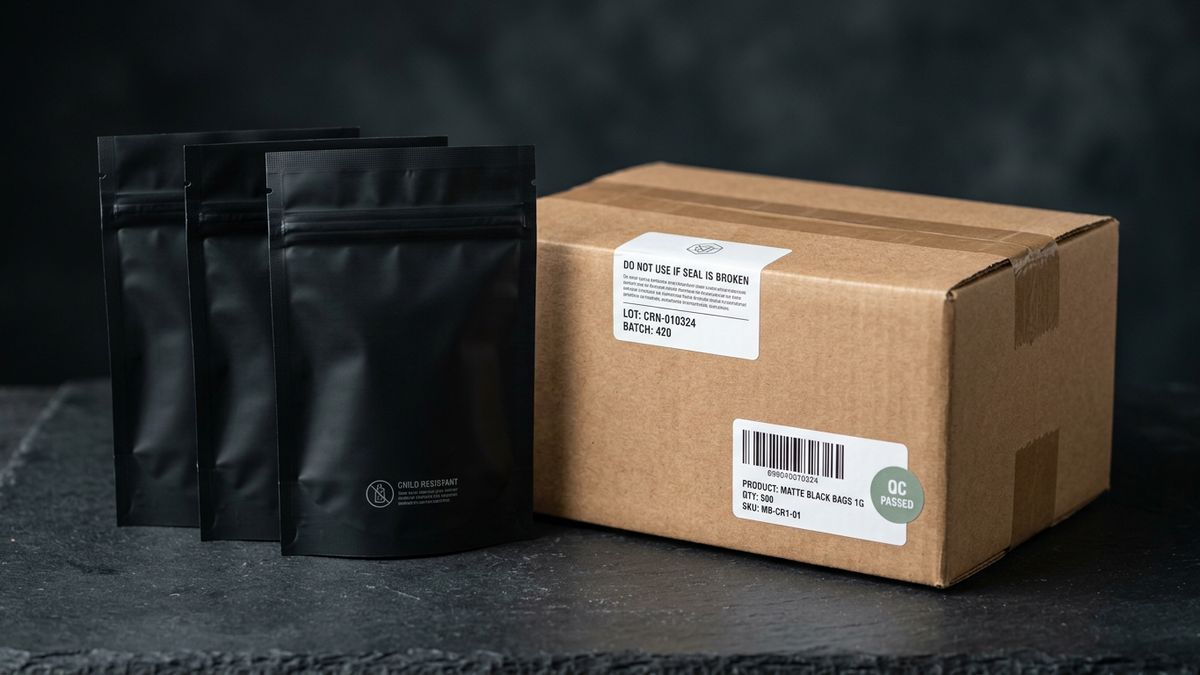
Cannabis packaging in British Columbia must satisfy two layers of rules. Health Canada sets the federal package and label requirements. The BC Liquor Distribution Branch (LDB), the province's sole wholesaler, adds its own supply chain specs: GS1 barcodes on every retail unit and master case, a BC excise stamp over the seal, smell-resistant retail packaging, and master cases capped at 36.0 cm x 30.48 cm x 30.48 cm and 18.1 kg (40 lbs).
CropPak is based in Abbotsford, BC, about an hour east of the LDB's Richmond Distribution Centre. I've spent about 20 years working in marketing and media connected to the cannabis industry, first through Growing Exposed on YouTube (130,000+ subscribers and 12.5 million views), then writing for High Times and Stoner Magazine, and now as owner of LG Digital Inc. A lot of the licensed producers (LPs) I talk to here in the Fraser Valley have the federal rules down cold and then get a shipment rejected at the Richmond DC over a barcode or a case size. That's the gap this guide fills.
This article covers only what's specific to British Columbia. For the federal rules on plain packaging, the standardized cannabis symbol, THC warnings and child-resistant containers, read our Health Canada packaging and labelling requirements hub and our cannabis packaging Canada pillar. Everything below sits on top of those.
Who Regulates Cannabis Packaging in British Columbia?
Two provincial bodies matter, and they do different jobs.
The Liquor and Cannabis Regulation Branch (LCRB) administers BC's Cannabis Control and Licensing Act and licenses private retail stores. The LCRB doesn't review your packaging artwork. It regulates how stores sell: age checks, hours of 9 a.m. to 11 p.m., a 30 gram per transaction cap, and a rule that cannabis must be sold in its original, never-opened packaging.
The BC Liquor Distribution Branch (LDB) is the only legal wholesaler of non-medical cannabis in the province under the Cannabis Distribution Act. The LDB runs the public BC Cannabis Stores (retail and online), operates the BC Cannabis Wholesale platform that private retailers order from, and receives all centrally distributed product at its Richmond Distribution Centre at 3389 No. 6 Road. The LDB is the body that writes the packaging and shipping specs you'll actually be checked against.
The LDB publishes its full requirements in the BC Wholesale Shipping Requirements Guide, last updated March 2026 with changes effective April 13, 2026. Read it in full before your first delivery. The summary below pulls out the parts that touch packaging.
How Does the BC Retail Model Affect Your Packaging?
British Columbia runs a hybrid retail model. Government-owned BC Cannabis Stores and privately licensed cannabis retail stores both operate, and both buy through the LDB. Under the Cannabis Control and Licensing Act, a single licensee can hold a maximum of eight retail store licences, and a federally licensed producer can't hold a retail store licence at all (with a separate producer retail store class as the exception).
Here's why that matters for packaging. In a hybrid market with hundreds of independent stores, your package does the selling on a shelf you don't control. BC retailers may open a package only to let a patron smell the product, and the opened unit can't be sold. So your sealed retail unit, the one with the excise stamp over the seal, is the only impression most customers get. Plain packaging rules limit what you can do, but finish, structure and bag quality still differ between brands. That's where a well-built custom mylar bag earns its cost.
Minimum age in BC is 19. Adults can buy up to 30 grams of dried cannabis or the equivalent per transaction, and possess up to 30 grams in public. Those limits come from the Province of BC's possession and purchasing limits page, and they shape your SKU sizes: 3.5 g, 7 g, 14 g and 28 g are the formats that fit inside a single legal purchase.
Central Delivery vs. Direct Delivery: Which Channel Are You Packaging For?
The LDB supports two distribution channels, and your packaging and labelling obligations change slightly depending on which one you use.
Central Delivery
Products are approved by the LDB Wholesale Cannabis Category Management team through periodic product calls, registered in LDB systems, delivered to the Richmond DC, and listed on BC Cannabis Wholesale for retailers to order. Only products selected through the LDB product selection process get registered for sale. The LDB publishes a listing decision within four weeks of a category submission deadline, then product registration takes roughly two weeks. Products that don't complete registration within 30 days of approval, or that don't reach the DC within 60 days, can be cancelled.
Direct Delivery
Direct Delivery lets eligible LPs ship straight to licensed retail stores, bypassing the Richmond DC. The program is built for small BC cultivators. Per the LDB's eligibility rules, the raw material must be sourced directly from eligible licensed cultivators in British Columbia producing less than 3,000 kg of dried, unpackaged cannabis per calendar year. The cultivator must register with the LDB before any product registration request. Three categories exist: Standard Direct Delivery, Section 119 Indigenous Nations Direct Delivery, and Production Retail Store Direct Delivery. The LP handles orders, delivery, returns and financial transactions with stores, then reports sales and remits markup to the LDB.
Direct Delivery products still need LDB registration, GS1 barcodes on retail units and shipping cases, and the BC excise stamp. You just skip the DC's receiving dock. Products can also be registered in both channels at once, which the LDB calls Dual Delivery. Dual Delivery products must keep identical attributes (pricing, potency, case pack) in both channels.
LDB Retail Unit Standards: What Must Be on Every Package
Section 4.2 of the LDB Shipping Requirements Guide sets the retail unit standards. Each retail selling unit must be pre-packaged, sealed and labelled before it arrives at the DC. Beyond the federal rules, the LDB adds the following:
- Smell-resistant packaging. The LDB requires that retail selling units be packaged in smell-resistant packaging. This isn't a Health Canada rule; it's a BC wholesaler rule. Multi-layer mylar with a food-grade inner layer handles this well. Our guide to smell-proof mylar bags explains the barrier layers that matter.
- GS1 barcodes with three data elements. Retail unit barcodes must be GS1 DataBar Expanded, GS1 DataBar Expanded Stacked or GS1 DataMatrix, and must encode the GTIN (AI 01), packaged-on date in YYMMDD format (AI 13), and the lot or batch number (AI 10). A plain UPC won't be accepted.
- Barcode placement. Barcodes must scan easily with standard RF equipment. On curved containers like bottles and cans, orient the barcode vertically. Lids and other elements can't obstruct it. Barcodes that don't scan on arrival may be rejected and returned.
- BC excise stamp over the seal. Every THC-containing retail unit must carry a British Columbia excise stamp placed so the product can't be opened without breaking the stamp. Wrong province, missing stamp or a stamp that doesn't bridge the seal means a rejected delivery.
- Lot-specific potency. Potency must be specific to lot and batch, match the Certificate of Analysis, and be printed in human-readable form. Actual potency outside the registered range gets the product returned.
- Lot code dating. Lot codes shouldn't carry multiple packaging dates more than one month apart.
The excise stamp placement is the detail that catches people. Design your package so a flat, uninterrupted surface runs across the opening. On a stand-up mylar bag, that usually means the stamp runs across the top heat seal or over the zipper edge. Test the placement before you print 10,000 bags.
LDB Master Case Standards: Dimensions, Weight, Labels
Section 4.3 of the LDB guide is where most packaging budgets get wasted. The DC distributes master cases to retailers without breaking them down, so the case has to work as a retail-ready shipper.
| LDB Master Case Requirement | Specification |
|---|---|
| Maximum dimensions | 36.0 cm long x 30.48 cm wide x 30.48 cm high |
| Maximum weight | 40 lbs (18.1 kg) |
| Contents | One SKU and one lot number per case; no inner packs |
| Closure | Tamper-evident (cardboard case sealed with security tape or glue) |
| Format | Rigid case; flats and trays not accepted; beverages can't ship loose |
| Labels | Two labels, one on the front and one on the side |
| Barcode format | GS1-128 encoding GTIN (01), packaging date YYMMDD (13), lot number (10) |
| Barcode placement | Flat on the case, not wrapped around a corner |
| Case configuration | Fixed at registration; one configuration per product; changes usually mean a new SKU |
The human-readable portion of each master case label must include the LP name, product name, product category, GTIN (or SCC for accessories), retail unit size or weight, retail units per case, lot number, packaged-on date, and the LDB SKU number (preferred). Barcode images for both the unit and the case must be emailed to the LDB for scan testing before your first shipment. The LDB warns that a digital sample passing under ideal conditions doesn't guarantee a pass on arrival if print quality, label size or placement is poor.
Case configuration is the planning trap. The number of retail units per case is locked at product registration, printed on the PO, and has to match what arrives. Changing it generally requires a new SKU. So pick your case count before you order cartons, and make sure the carton you spec fits inside 36.0 x 30.48 x 30.48 cm with the units you've committed to. A 12-count of 28 g bags and a 50-count of 3.5 g bags need different boxes, and both have to stay under 18.1 kg loaded.
How Does British Columbia Compare to Other Provincial Wholesalers?
Every Canadian province runs its own wholesale body with its own supply chain guide. If you sell into more than one province, you'll build a packaging spec that satisfies the strictest requirement across all of them. Here's how BC's verified requirements line up against the questions you'll need to answer for each market:
| Requirement | British Columbia (LDB) | Why it matters for packaging |
|---|---|---|
| Wholesaler | BC Liquor Distribution Branch | Single registration, single set of case specs |
| Retail model | Hybrid: public BC Cannabis Stores + private licensed stores | Shelf presence matters across hundreds of independent retailers |
| Minimum age | 19 | Same as most provinces |
| Retail unit barcode | GS1 DataBar Expanded, Expanded Stacked or DataMatrix with GTIN, date, lot | Requires variable-data printing or lot-level labels |
| Case barcode | GS1-128 with GTIN, date, lot | Case labels print per lot, not per SKU |
| Case size limit | 36.0 x 30.48 x 30.48 cm, 18.1 kg | Sets your carton and unit count |
| Smell-resistant retail unit | Required by LDB | Favours multi-layer mylar and lined rigid containers |
| Direct-to-retail channel | Direct Delivery for BC cultivators under 3,000 kg/year | Small LPs can skip the DC but still need full GS1 labelling |
The practical takeaway: if your packaging passes the LDB's barcode and case specs, you've done most of the hard work for the other provinces too. The GS1 three-element barcode and the retail-ready master case are the common thread. We cover the national picture, including bag formats and sizing for Canadian SKUs, in our mylar bags Canada guide.
Child-Resistant and Tamper-Evident: What BC Adds to the Federal Rule
Child resistance is a federal requirement, not a BC one, so I won't repeat the Health Canada rules here. One thing worth knowing if you source packaging from a North American supplier: the child-resistant test protocol used across the continent is 16 CFR 1700.20, the panel test with 50 children aged 42 to 51 months and 100 adults aged 50 to 70. ASTM D3475 classifies the CR package types. Ask your supplier for the actual test report for the exact bag or jar you're buying, not a generic certificate. Our child-resistant mylar bags ship with the report for each construction.
What BC adds is tamper evidence at two levels. The retail unit gets the BC excise stamp over the seal. The master case has to be tamper-evident on its own, sealed with security tape or glue. If you're using a resealable zipper bag, the heat seal above the zipper is your tamper-evident feature, and the excise stamp goes across it.
Sourcing Compliant Packaging in British Columbia
CropPak manufactures factory-direct from Abbotsford, which puts us in the same region as the LDB's Richmond DC and most of the Lower Mainland's processors. Here's how we set up a BC order so it clears receiving the first time:
- Confirm the case configuration first. We ask for your registered units-per-case before quoting cartons, because that number is locked with the LDB.
- Spec the master case to the LDB limits. Every shipper we build for BC stays inside 36.0 x 30.48 x 30.48 cm and under 18.1 kg loaded, with two flat label panels (front and side) for the GS1-128 labels.
- Build the excise stamp zone into the artwork. We mark a clear, flat zone across the seal on the dieline so the stamp bridges the opening cleanly.
- Leave a lot-label area. Because retail unit barcodes carry the packaging date and lot number, most LPs print those on a secondary label at packaging time. We reserve a flat matte panel on the bag so the label sticks and scans.
- Use smell-resistant construction by default. Our standard Canadian bag is a multi-layer mylar with a food-grade inner layer that meets the LDB's smell-resistant requirement without a separate liner.
Minimum order quantities for custom printed bags start at 1,000 pieces per SKU, which fits the volumes most Direct Delivery producers run. If you're not sure what quantity to commit to while your LDB listing is pending, read our cannabis packaging MOQ guide for how to split runs across SKUs.
Common BC Packaging Mistakes That Get Shipments Rejected
These are the issues the LDB guide specifically says will lead to rejection or return, and the ones I hear about most from BC producers:
- UPC instead of GS1 DataBar or DataMatrix on the retail unit. The LDB only accepts the GS1 formats listed in Section 4.5, and each needs GTIN, packaging date and lot.
- Case barcode wrapped around a corner. It has to lie flat and scan with standard RF equipment.
- Inner packs inside the master case. Not accepted. One SKU, one lot, retail-ready.
- Master case over 18.1 kg or over 36.0 cm long. Dense products like beverages and 28 g flower hit the weight cap fast.
- Excise stamp that doesn't bridge the seal, or an Ontario or Alberta stamp on BC product. Rejected and returned.
- Mixed packaging dates in one lot more than a month apart. Flagged at receiving.
- Shipping a new case configuration without a change request. Send the change request to the LDB vendor team and wait for approval before you ship.
Fixing any one of these after the fact means reworking product that's already packaged, stamped and sealed. Building the spec right the first time is cheaper by a wide margin.
If you're launching in British Columbia or adding a BC SKU, send us a quote request with your registered case count and product formats. We'll price the retail bags, the master cases and shipping to your facility all-in, usually the same day, and we'll flag anything in your spec that won't clear the Richmond DC.
Frequently asked questions
Who is the cannabis wholesaler in British Columbia?
What are the LDB master case size and weight limits for cannabis?
What barcode format does BC require on cannabis packaging?
Does British Columbia require smell-proof cannabis packaging?
Who qualifies for the LDB Direct Delivery program in BC?