Cannabis Packaging MOQ: MOQs Explained
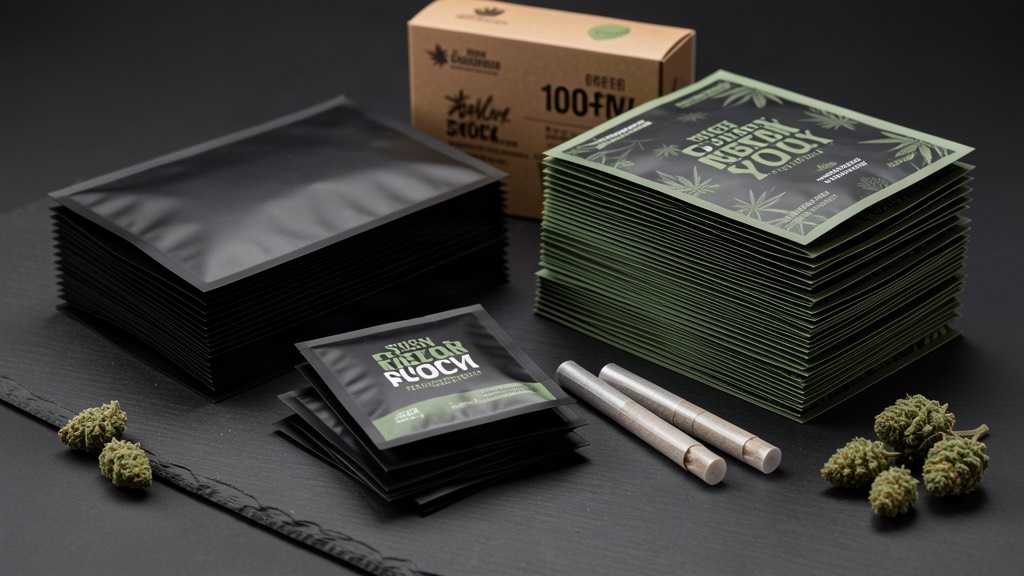
A cannabis packaging MOQ (minimum order quantity) is the smallest number of units a supplier will let you order for a given product. Stock cannabis packaging typically has MOQs of 100 to 1,000 units. Digital custom printing starts at 1,000 to 5,000 units. Gravure printing — the lowest per-unit cost — requires 10,000 to 50,000+ units. Your monthly volume determines which tier makes sense, and ordering below a supplier's MOQ means paying a premium or getting turned away entirely.
I've spent about 20 years working in marketing and media connected to the cannabis industry. I created Growing Exposed on YouTube — we've built an audience of over 130,000 subscribers and 12.5 million views. I've also written for High Times and Stoner Magazine, and I own LG Digital Inc. So when brands ask me why their packaging supplier won't let them order 500 custom-printed mylar bags, I've seen enough small brands get stuck on this exact problem to give them a straight answer.
Here's everything you need to know about cannabis packaging MOQs: how they work, why suppliers set them, what to expect by product type, and how to get what you need without overcommitting your cash.
What Is a Cannabis Packaging MOQ and Why Does It Matter?
MOQ stands for minimum order quantity. It's the floor — the fewest units a supplier will produce or sell in a single order. If a supplier lists a MOQ of 5,000 for custom-printed mylar bags, you can't order 500. You either order 5,000 or you find a different supplier.
MOQs matter because they directly affect your cash flow, your storage requirements, and your per-unit cost. A 5,000-unit order at $0.25 per bag is $1,250 in packaging. A 500-unit order at a broker that accepts low MOQs might cost $0.60 per bag — $300 total, but you're paying 2.4x more per unit for the same bag.
For cannabis brands, MOQ is a cash flow question as much as a sourcing question. If you're moving 2,000 units per month of a single SKU, a 10,000-unit MOQ means tying up five months of packaging inventory in one order. If you're moving 20,000 units per month, that same 10,000-unit MOQ is a two-week supply. The same MOQ that's a burden for a small brand is a non-issue for a larger one.
The full MOQ guide on our site breaks down the three production tiers in detail. Here in the blog post, I'll cover what actually matters for your brand's decision-making.
How Do MOQs Work for Different Types of Cannabis Packaging?
Every packaging type has a different MOQ because every type has different setup costs, tooling requirements, and production methods. Here's what you can expect for each major cannabis packaging category:
| Packaging Type | Stock MOQ | Digital Custom MOQ | Gravure Custom MOQ | Typical Lead Time |
|---|---|---|---|---|
| Mylar bags | 100-500 units | 1,000-5,000 units | 10,000-25,000 units | 2-4 weeks (stock), 4-6 weeks (custom) |
| Pre-roll tubes | 500-1,000 units | 5,000-10,000 units | 10,000-50,000 units | 2-3 weeks (stock), 4-6 weeks (custom) |
| Pre-roll boxes | 500-1,000 units | 5,000-10,000 units | 10,000-25,000 units | 3-4 weeks (stock), 5-7 weeks (custom) |
| Vape cartridge boxes | 500-1,000 units | 5,000-10,000 units | 10,000-25,000 units | 3-4 weeks (stock), 5-7 weeks (custom) |
| Cannabis labels | 500 units | 1,000-5,000 units | 10,000-50,000 units | 1-2 weeks (stock), 2-4 weeks (custom) |
| CR mylar bags | 500-1,000 units | 5,000-10,000 units | 10,000-25,000 units | 3-4 weeks (stock), 5-7 weeks (custom) |
Notice the pattern: the more customization involved — custom printing, custom sizes, custom materials — the higher the MOQ. Stock products have low MOQs because they're already in production. Custom products have high MOQs because each order requires a separate production run with setup, tooling, and quality control.
What's the Difference Between Stock, Digital, and Gravure MOQ Tiers?
There are three production tiers for custom cannabis packaging, and each one has a different MOQ range. Understanding these tiers is the key to figuring out where your brand belongs.
Stock Packaging (100-1,000 Units)
Stock packaging is pre-manufactured with no custom printing. You buy blank mylar bags, plain pre-roll tubes, or unprinted boxes in standard sizes. The supplier already has these in inventory or can produce them in bulk without any setup for your specific design.
Stock MOQs are low — often 100 to 500 units — because the supplier doesn't need to set up a custom print run. You can order what you need, when you need it, without committing to a large inventory.
The downside: no branding. Stock packaging looks generic. If you're selling in a competitive dispensary market, unmarked bags don't help you stand out. Many brands use stock packaging with custom compliance labels as a bridge — the label carries the brand identity while the bag is stock.
Digital Custom Printing (1,000-5,000 Units)
Digital printing uses digital presses that don't require physical printing plates. Your artwork goes straight from file to printer, which means setup costs are minimal. That's why digital MOQs start lower than gravure — typically 1,000 to 5,000 units.
Digital printing is ideal for brands that need custom branding but can't justify a 10,000-unit gravure order. The per-unit cost is higher than gravure, but the lower MOQ means less cash tied up in inventory. For a brand moving 1,000 to 3,000 units per month, digital is the sweet spot.
The trade-off: digital printing has slightly lower print quality than gravure for large solid color areas, and per-unit costs are 20-40% higher. But you're not paying $2,000-$5,000 in gravure cylinder tooling either.
Gravure Custom Printing (10,000-50,000+ Units)
Gravure printing (also called rotogravure) uses engraved metal cylinders to transfer ink onto the packaging film. Each color requires its own cylinder, and the cylinders cost $400-$800 per color to manufacture. A typical 6-color design (CMYK plus white plus one Pantone) costs $2,400-$4,800 in tooling.
That tooling cost is why gravure MOQs start at 10,000+ units. The supplier needs to amortize the cylinder cost across enough units to keep the per-unit tooling cost reasonable. At 10,000 units, $3,000 in tooling adds $0.30 per unit. At 50,000 units, it adds $0.06 per unit.
The benefit: gravure has the lowest per-unit cost at volume and the highest print quality. Once you're past the tooling cost, reorders with the same design drop significantly in price — often 30-50% below digital printing.
| Tier | MOQ Range | Per-Unit Cost | Tooling Cost | Best For |
|---|---|---|---|---|
| Stock | 100-1,000 | $0.08-$0.25 | $0 | New brands, product launches, low-volume SKUs |
| Digital Custom | 1,000-5,000 | $0.15-$0.45 | $0-$200 (setup) | Growing brands, mid-volume SKUs, seasonal products |
| Gravure Custom | 10,000-50,000+ | $0.08-$0.25 (after tooling) | $2,400-$4,800 | Established brands, high-volume SKUs, reorders |
Why Do Cannabis Packaging Suppliers Set Minimum Order Quantities?
Suppliers don't set MOQs to be difficult. They set them because of real production costs. Understanding what drives those costs helps you negotiate better terms and choose the right supplier.
The main factors that determine MOQ:
- Setup time: Every custom production run requires machine setup, calibration, and quality control checks. A gravure press takes 2-4 hours to set up for a new design. That setup cost is the same whether you're printing 1,000 bags or 50,000. At 1,000 units, the setup cost per bag is significant. At 50,000, it's negligible.
- Tooling costs: Gravure cylinders, flexo plates, and die-cutting tools are one-time costs that must be amortized across the order. A $3,000 cylinder set on a 1,000-unit order adds $3 per bag. On a 50,000-unit order, it adds $0.06.
- Material minimums: Film suppliers have their own MOQs. A roll of PET/AL/LLDPE film might come in minimum quantities that produce 10,000+ bags. If a packaging supplier can't use a full roll on your order, they're wasting material — and they won't accept orders that small.
- Labor costs: Each production run requires machine operators, quality control staff, and packaging handlers. These are fixed costs per run, regardless of order size.
- Quality control: Child-resistant packaging requires CPSC testing under 16 CFR 1700.20. Each production lot requires testing documentation, which costs $200-$500 per lot regardless of lot size. Larger lots spread that cost more efficiently.
When a supplier says their MOQ is 10,000 units, they're not being greedy. They're telling you the break-even point where the order makes economic sense for their production line. Ordering below that means they'd lose money on the run.
How Can Small Cannabis Brands Work Around High MOQs?
If you're a small brand moving 500-2,000 units per month of a given SKU, a 10,000-unit MOQ doesn't make sense. Here are five strategies I've seen work:
1. Use Stock Packaging with Custom Labels
Buy stock mylar bags, pre-roll tubes, or boxes at low MOQs (100-1,000 units) and apply custom-printed labels. The label carries your brand identity, potency information, and compliance text. The bag itself is unbranded but functional. This approach gives you custom branding at stock-packaging MOQs — often 500 units instead of 10,000.
Labels typically have MOQs of 500 to 1,000 units and cost $0.05 to $0.08 per label at 10,000 units, or $0.10 to $0.20 at lower volumes. Combined with stock bags at $0.08 to $0.15 per unit, your total packaging cost runs $0.18 to $0.35 per unit — higher than full custom but with a fraction of the inventory commitment.
2. Group Multiple SKUs Into One Order
If you have multiple strains or products, combine them into a single order that meets the MOQ. A 10,000-unit MOQ split across 4 strains means 2,500 bags per strain — a 6-week supply if you're moving 400 units per strain per month. The key is that all SKUs use the same bag size and material, with different labels or print artwork for each strain.
3. Start with Digital, Move to Gravure Later
Use digital printing for your first order at 1,000-5,000 units. When your volume grows past 5,000 units per month, switch to gravure. You'll pay more per unit on the first order, but you won't tie up $3,000+ in tooling for a product that might not sell.
4. Use a Supplier with Tiered MOQs
Factory-direct suppliers like CropPak offer tiered MOQs that scale with your needs. You can start at 1,000 units with digital printing and move to 10,000+ with gravure as your volume grows — all with the same supplier, same bag construction, same quality. No need to switch suppliers or requalify materials when you scale up. Check our quote request page for tiered pricing on your specific product.
5. Share Tooling Costs with Other Brands
If you know another brand using the same bag size, you can sometimes split a gravure order. Both brands share the tooling cost, and each gets custom-printed bags at a lower per-unit price. This requires coordination and a supplier willing to manage a shared run, but it's a viable strategy for brands in the same collective or co-op.
When Should You Switch from Stock to Custom Cannabis Packaging?
The decision to move from stock to custom packaging comes down to volume and brand strategy. Here's a simple framework:
Stay with stock if: You're moving fewer than 1,000 units per month of any single SKU. The per-unit cost difference between stock and custom isn't enough to justify the inventory commitment. Focus your budget on product quality and dispensary relationships.
Move to digital custom if: You're moving 1,000 to 5,000 units per month. At this volume, custom branding starts to matter for shelf differentiation, and the per-unit cost of digital printing is close enough to stock that the branding benefit justifies the slightly higher cost. This is where most growing brands live.
Move to gravure if: You're moving more than 5,000 to 10,000 units per month of a single SKU. The crossover point where gravure becomes cheaper than digital is around 7,000-8,000 units per order. At 10,000 units, gravure costs roughly $0.48 per unit including tooling amortization, versus $0.55 for digital. On reorders, gravure drops to $0.18-$0.25 per unit — significantly below digital.
Don't jump to gravure too early. If you order 10,000 units and your product doesn't sell, you're sitting on $2,500-$5,000 in packaging inventory that may never get used. Cannabis packaging has a shelf life — ink can fade, materials can degrade, and regulations can change. We cover this in detail in our cannabis packaging 101 guide.
How Does Factory-Direct Sourcing Affect Your MOQ and Pricing?
Factory-direct sourcing means buying directly from the manufacturer rather than through a broker or distributor. The impact on MOQ and pricing is significant.
Brokers typically offer lower MOQs because they aggregate orders from multiple brands. A broker might let you order 500 custom-printed bags because they're combining your order with orders from 5 other brands, all using the same bag size. The factory produces one large run, and the broker distributes the bags to each brand.
The trade-off is price. Brokers charge 30-50% more per unit than factory-direct suppliers because they need margin. A bag that costs $0.15 factory-direct might cost $0.25-$0.30 through a broker. On a 10,000-unit order, that's $1,000-$1,500 in broker markup.
Factory-direct suppliers like CropPak offer both competitive MOQs and lower per-unit pricing because there's no broker in the middle. You're buying from the same factory that produces the bags, with no intermediary markup. The MOQ might be slightly higher than a broker's, but the per-unit savings compound quickly — especially on reorders.
For a detailed breakdown of how factory-direct pricing compares to broker pricing, see our factory-direct vs broker comparison.
Here's a quick comparison of how your per-unit cost changes based on sourcing method and order size:
| Order Size | Broker Per-Unit | Factory-Direct Per-Unit | Savings |
|---|---|---|---|
| 1,000 units | $0.35-$0.50 | $0.25-$0.35 | 25-30% |
| 5,000 units | $0.25-$0.40 | $0.15-$0.25 | 30-40% |
| 10,000 units | $0.20-$0.35 | $0.12-$0.22 | 35-45% |
| 50,000 units | $0.15-$0.25 | $0.08-$0.15 | 40-50% |
The larger your order, the bigger the savings from factory-direct sourcing. At 50,000 units, you're saving 40-50% compared to broker pricing — which can be $3,500-$5,000 on a single order.
What About MOQs for Child-Resistant Cannabis Packaging?
Child-resistant packaging adds another layer to the MOQ calculation. CR packaging requires certification testing under 16 CFR 1700.20, and that testing costs $2,000-$5,000 per SKU. The test uses 200 children aged 42-51 months and 100 adults aged 50-70 — it's not a quick check, it's a full protocol.
What this means for MOQ: CR-certified packaging often has higher MOQs than non-CR packaging because the supplier needs to spread the certification cost across more units. A CR mylar bag might have a MOQ of 5,000 units while the same bag without CR certification has a MOQ of 1,000 units.
Don't skip CR certification to save on MOQ. Every legal U.S. state requires child-resistant packaging for cannabis products. If your packaging isn't certified, you can't legally sell it — period. For more on this, read our CR certification guide and our child-resistant packaging requirements guide.
How to Calculate Your Ideal Cannabis Packaging MOQ
Here's a simple formula to figure out the right MOQ for your brand:
Monthly volume × Months of inventory you can afford = Target order size
If you sell 2,000 units per month and can afford to hold 3 months of inventory, your target order is 6,000 units. That puts you in the digital printing tier (1,000-5,000) or the lower end of gravure (10,000+), depending on the supplier.
Factor in these considerations:
- Cash flow: Can you afford to tie up $1,500-$5,000 in packaging inventory? If not, order smaller and accept a higher per-unit cost.
- Storage space: 10,000 mylar bags take up roughly 2-3 cubic feet of shelf space. 50,000 bags take 10-15 cubic feet. Make sure you have climate-controlled storage.
- Product shelf life: If your product has a 6-month shelf life, don't order 12 months of packaging. Packaging can sit, but it shouldn't sit for years.
- Regulatory changes: If your state is considering packaging regulation changes, don't commit to a large inventory of packaging that might become non-compliant. Our state-by-state packaging guide tracks current requirements.
- Design changes: Are you planning a brand refresh in the next 6 months? If so, a smaller MOQ gives you flexibility to change your artwork without writing off unused packaging.
Frequently Asked Questions
What is the minimum order quantity for cannabis packaging?
Stock cannabis packaging has MOQs of 100 to 1,000 units. Digital custom printing starts at 1,000 to 5,000 units. Gravure printing (the lowest per-unit cost) requires 10,000 to 50,000+ units. Your monthly volume determines which tier makes sense — under 1,000 units per month, use stock. From 1,000 to 5,000, use digital. Above 5,000 to 10,000, evaluate gravure. Factory-direct suppliers like CropPak offer all three tiers so you can scale without switching suppliers.
Why do cannabis packaging suppliers have minimum order quantities?
MOQs exist because of fixed production costs: machine setup (2-4 hours per run), tooling ($2,400-$4,800 for gravure cylinders), material minimums from film suppliers, labor for each production run, and quality control testing ($200-$500 per lot). These costs are the same whether you order 500 or 50,000 units. Suppliers set MOQs at the point where per-unit fixed costs become reasonable. Below that point, they'd lose money on the order.
Can I order custom-printed cannabis packaging with a low MOQ?
Yes, but your options are limited. Digital printing offers MOQs as low as 1,000 to 5,000 units for custom-printed mylar bags and labels. Below 1,000 units, most suppliers can't justify the setup cost for custom printing. The workaround is stock packaging with custom labels — buy blank bags at 100-500 unit MOQs and apply custom-printed labels. You get branding without the custom-printing MOQ. The per-unit cost is higher but the cash commitment is much lower.
How much does tooling cost for custom cannabis packaging?
Gravure printing cylinders cost $400-$800 per color. A typical 6-color design (CMYK plus white plus one Pantone) costs $2,400-$4,800 in tooling. Digital printing has minimal tooling ($0-$200 in setup fees). Flexo plates cost $150-$400 per color. Tooling is a one-time upfront cost — it's amortized across all units in the order. On reorders with the same design, you don't pay tooling again, which is why reorders drop 30-50% in per-unit cost.
Should I choose a higher MOQ to get a lower per-unit cost?
Only if you can sell through the inventory before it becomes obsolete. A 50,000-unit order at $0.10 per bag ($5,000 total) saves money per bag compared to a 5,000-unit order at $0.25 ($1,250 total). But if it takes you 18 months to sell 50,000 units and your state changes packaging regulations in month 12, you've got 20,000 bags you can't use. Match your MOQ to your realistic 3-6 month sales forecast. Don't overcommit cash to packaging inventory that could become non-compliant or unused.
Frequently asked questions
What is the minimum order quantity for cannabis packaging?
Why do cannabis packaging suppliers have minimum order quantities?
Can I order custom-printed cannabis packaging with a low MOQ?
How much does tooling cost for custom cannabis packaging?
Should I choose a higher MOQ to get a lower per-unit cost?