Cannabis Packaging Ontario: OCS Supplier Guide

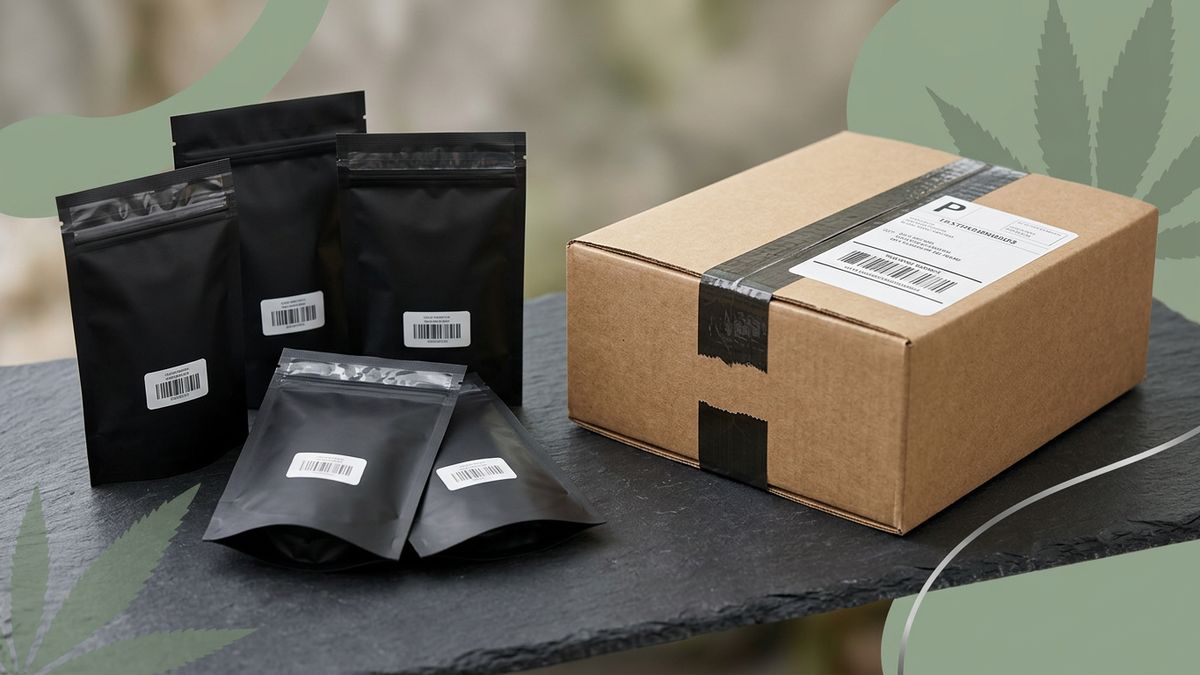
Cannabis packaging in Ontario has to pass two checkpoints. Health Canada sets the federal package and label rules. The Ontario Cannabis Store (OCS), the province's only legal cannabis wholesaler, adds its own supply chain specs: GS1 barcodes at every packaging level, two GS1-128 labels on each master case, tamper tape on every case, one lot per case, and full-case quantities only.
I've spent about 20 years working in marketing and media connected to the cannabis industry. That started with Growing Exposed on YouTube (130,000+ subscribers and 12.5 million views), ran through bylines in High Times and Stoner Magazine, and today I own LG Digital Inc. The Ontario producers I talk to rarely get tripped up by the federal rules. They get tripped up at the OCS distribution centre over a glossy barcode, a lot number with a slash in it, or a master case that showed up with two lots inside.
This guide covers only what's specific to Ontario. For plain packaging, the THC warning, the standardized symbol and child-resistant container rules, start with our Health Canada packaging and labelling requirements hub and our cannabis packaging Canada pillar. Everything below sits on top of those.
Who Regulates Cannabis Packaging in Ontario?
Ontario splits the job between two provincial bodies, and neither one rewrites the federal packaging rules.
The Ontario Cannabis Store (OCS) is the trade name of the Ontario Cannabis Retail Corporation, a Crown agency. According to the AGCO's overview of Ontario's retail landscape, the OCS is the only legal wholesaler of cannabis for private retail stores and runs the province's online store at OCS.ca. If you're a licensed producer (LP) selling into Ontario, the OCS is your customer, and its Supplier Manual is the document your packaging gets checked against.
The Alcohol and Gaming Commission of Ontario (AGCO) licenses and regulates private retail stores under the Cannabis Licence Act, 2018. The AGCO doesn't regulate the OCS and doesn't approve your artwork. It controls how stores sell: store authorizations, ID checks, hours and how product moves from shelf to customer.
Here's the practical split. The OCS decides whether your package can enter the Ontario supply chain. The AGCO decides what a store can do with that package once it arrives.
How Does Ontario's Retail Model Shape Your Packaging?
Ontario runs a private bricks-and-mortar retail model with one government online store. Private stores must buy their cannabis from the OCS, and under section 18 of the Cannabis Licence Act they can only sell it in the packaging in which it was purchased from the OCS. Your sealed retail unit is the finished product. Nobody downstream repacks it.
The numbers that matter, all from Ontario government and AGCO sources:
- Minimum age: 19 to buy, use, possess or grow, per the Ontario cannabis laws page.
- ID checks: anyone who appears under 25 must show ID before entering a store (O. Reg. 468/18, s. 20).
- Purchase limit: 30 grams of dried cannabis or equivalent per visit in person, or per single online or phone transaction.
- Store hours: 7 a.m. to 11 p.m. on any day.
- Ownership cap: one operator and its affiliates can hold up to 150 retail store authorizations.
- Location: stores must sit at least 150 metres from a school or private school.
- Delivery: stores that deliver must hand over cannabis in its original, unopened packaging.
A 150-store cap means Ontario has big retail chains with real buying power sitting alongside independents. Your package competes on crowded walls with hundreds of SKUs. The AGCO notes that stores may use sensory display containers so shoppers can see and smell product, which means the sealed unit doesn't get opened at the counter. Plain packaging limits colour and graphics, but structure, finish and print quality still separate brands. That's where a well-specified custom mylar bag pays for itself.
The 30 gram cap also caps your SKU sizes. The OCS's own recommended case packs list dried flower in 1 g, 3.5 g, 5 g, 7 g, 10 g, 14 g, 15 g, 21 g, 28 g and 30 g formats. Anything bigger can't be sold in a single legal transaction.
How Do You Get Listed with the OCS?
The OCS buys through a structured Product Call. According to the OCS supplier site, Doing Business with OCS, it currently runs five Product Calls per calendar year, and successful suppliers receive a Notice to Purchase (NTP) within about 20 business days of the submission deadline. You need a Health Canada licence that authorizes sales to a provincially authorized distributor before you submit anything.
Packaging shows up at almost every step of onboarding. The NTP package asks for:
- Retail packaging and product images, shot through GS1 Canada
- Barcodes for every packaging level
- Label artwork for all containers, both immediate and outermost
- A Child Resistance Certificate for the immediate container
- The Cannabis Product Specification Form
That Child Resistance Certificate is where your packaging supplier earns its keep. Federal rules define a child-resistant package by reference to recognized test standards, and many CR mylar bags on the market are certified under the U.S. protocol in 16 CFR 1700.20, with the package classified under ASTM D3475. Get the actual test report from your supplier, matched to the exact bag size and zipper you're buying. A certificate for a 3.5 g bag doesn't cover your 28 g bag. Our breakdown of child-resistant mylar bag certification and testing walks through what a real report looks like.
The OCS reviews your packaging more than once
The OCS Regulatory Compliance team reviews labels and packages at the Product Call or before a PO, at the first shipment, on an ongoing basis for inbound shipments, and during any quality investigation. If they flag a non-conformance, the OCS Supplier Manual (updated July 2023) gives you two business days to respond with amended labels, a plan to amend them, or a rationale for why they comply.
Change a package after it's been reviewed and you have to notify the OCS and submit it again. Products moving to new packaging also have to ship on a separate PO, never mixed with old packaging on the same order. If you're planning a redesign, build that transition into your purchase schedule.
Farmgate stores
Ontario lets LPs run one AGCO-authorized retail store at a production facility in the province. These are called Farmgate Stores. Per the the OCS Farmgate program page, Farmgate operators still sell their product to the OCS and buy it back wholesale, but the product doesn't have to travel to the OCS distribution centre first. The packaging still has to meet every OCS and federal requirement, so don't treat Farmgate as a shortcut on labels.
What Are the OCS Barcode Requirements for Cannabis Packaging in Ontario?
Barcodes are the single most common reason I hear about Ontario shipments getting held. The OCS requires every cannabis supplier to go through GS1 Canada for GTINs, barcode symbology, product images and registry in the ECCnet Registry.
From the OCS barcode standards page:
- Retail units: GS1 DataBar Expanded or DataBar Expanded Stacked.
- Cases and logistics packaging: GS1-128.
- Data encoded, in this order: GTIN (AI 01, 14 digits), packaged-on date (AI 13, YYMMDD) or the default 500723 if there's no packaged-on date, then lot (AI 10, up to 20 alphanumeric characters).
- Unique GTINs: each packaging level needs its own GTIN, and each size variant needs its own barcode. One strain sold in 1 g, 3.5 g, 7 g and 14 g needs four retail barcodes.
- Matching data: the lot and packaged-on date on the inner pack and master case must match the retail unit inside.
- First-pass scans: every barcode at every level must scan on the first pass.
The OCS won't accept AI 90 (mutually agreed data) in any barcode. And if a shipment arrives with non-compliant barcodes, it's sent back or you pay the rework costs to relabel. Rework also delays your listing on OCS.ca.
Packaging details that break barcodes
This is where packaging choices and barcode compliance collide. The Supplier Manual's GS1 checklist calls out problems that start at the print stage:
- Gloss: glossy surfaces reflect scanner light and distort DataBars. Print the barcode area matte or put the barcode on a matte label.
- Curved surfaces: on bottles and round containers, the OCS recommends matte labels with a stacked barcode.
- Quiet zone: leave clear space of 10 times the narrowest bar or 0.3175 cm (0.125 in), whichever is greater. No border lines around the barcode.
- Flat placement: barcodes need to sit on flat surfaces and appear in full, with no truncation.
- Human-readable text: beneath or beside the barcode, and it must match the encoded data.
Lot numbers trip people up too. The OCS RF scanners can't read these characters, so keep them out of your lot codes: backslash, @, #, $, ^, braces, square brackets, parentheses, forward slash, % and quotation marks.
If you're ordering printed bags, tell your supplier where the barcode will go before artwork is final. On a soft-touch or high-gloss mylar bag, I'd plan a matte window or a matte compliance label for the barcode. It's a cheap fix at the design stage and an expensive one at the dock. Our custom cannabis labels guide covers label stock and finish options.
What Does the OCS Require on Master Cases and Inner Packs?
Your retail package might be perfect and still get refused because of the box it shipped in. Per the OCS Supplier Manual, each master case must have:
- A product description, including size
- The packaged-on date, which must match the retail unit
- A scannable GS1-128 barcode with GTIN, packaged-on date (or default) and lot
- The quantity of inner packs per case and units per inner pack
- Two labels, one front-facing and one on the side
Inner packs, if you use them, need their own GS1 label with the same core data. The rest of the case rules:
- The master case must be fully enclosed, rectangular or square. No round or irregular shapes.
- One lot and one expiry date per case. No mixed lots.
- Full case quantities only. Partial cases won't be accepted under any circumstances.
- All master cases for the same item must be the same size. Size changes need OCS approval through a Change Request Form.
- Tamper tape is required for all cannabis products, and it can't cover the logistics barcode.
- Don't use clear tape over master case labels, and don't print the DC address on the case.
- Cases and inner packs can't expose product to open air or light.
For new SKUs, the OCS recommends master cases of at least 20 cm wide, 20 cm deep and 15 cm high, weighing between 0.68 kg (1.5 lbs) and 9.98 kg (22 lbs). Going over those dimensions needs written OCS approval. The manual also suggests perforated tear strips or protective inserts under the flaps so DC staff don't need knives, which protects your retail units from cuts. Pair the case with retail units that carry their own tamper-evident seals and you've covered both layers.
OCS recommended case packs
The OCS publishes recommended units per master case and inner pack. These aren't hard rules, but matching them makes your SKU easier to slot into the DC and retailer orders.
| Subcategory | Consumer unit | Units per master case | Units per inner pack |
|---|---|---|---|
| Dried flower | 1 g, 3.5 g | 48 | 12 |
| Dried flower | 5 g, 7 g, 10 g, 14 g, 15 g | 24 | 6 |
| Dried flower | 21 g, 28 g, 30 g | 12 | 6 |
| Pre-rolls | All | 48 | 12 |
| Vapes | All | 24 | 6 |
| Concentrates | All | 24 | 6 |
| Oils and capsules | All | 24 | 6 |
| Edibles | All | 48 | 12 |
| Beverages | All | 24 | 12 |
Source: OCS Supplier Manual, Case Labelling Requirements, July 2023.
Run the math on a 3.5 g flower SKU. At 48 units per case, a run of 2,400 bags fills exactly 50 master cases. Size your bag order to whole cases, because the OCS won't take a partial one.
What Happens at the OCS Distribution Centre?
Every shipment gets checked on arrival. The OCS inspects for a compliant master case label, proper barcode scans and a complete certificate of analysis. A non-compliant barcode or lot mismatch can trigger rework at the DC, and the OCS will contact you to approve the charges.
A few rules that affect how you pack and palletize:
- Excise stamps: product without the required excise stamp, with a badly damaged stamp, a stamp that won't stay stuck, or a stamp covering mandated label elements is quarantined and shipped back at your cost. Plan a clear stamp zone on your artwork so the stamp doesn't land on the health warning.
- Damaged packaging: loose or partially open lids, damaged outer packaging or damaged labels mean immediate quarantine, return or destruction at your cost.
- Pallets: maximum height of 1.82 metres (6 feet), full layers, clear stretch wrap only, and a placard on at least two adjacent sides.
- Temperature: for temperature-sensitive products like edibles, extracts, vapes and topicals, the OCS recommends transport between 5°C and 22°C with TempTale data loggers.
- Samples first: you must send samples of master case and retail labels to the OCS before the first shipment of any product.
That last point is the one I'd circle. A sample review costs you a few days. A refused truckload costs you a launch window.
Ontario vs. British Columbia: How Do the Wholesaler Specs Compare?
CropPak is based in Abbotsford, BC, and a lot of our clients ship into both provinces. The two wholesalers line up on GS1 data but split on case format. Here's a side-by-side using the OCS Supplier Manual and the BC LDB Wholesale Shipping Requirements Guide.
| Requirement | Ontario (OCS) | British Columbia (LDB) |
|---|---|---|
| Wholesaler | Ontario Cannabis Store (OCRC) | BC Liquor Distribution Branch |
| Retail regulator | AGCO | LCRB |
| Inner packs | Accepted and recommended | Not accepted |
| Master case size | Recommended min 20 x 20 x 15 cm | Max 36.0 x 30.48 x 30.48 cm |
| Master case weight | Recommended 0.68 to 9.98 kg | Max 18.1 kg |
| Case labels | Two (front and side), GS1-128 | Two (front and side), GS1-128 |
| Barcode data | GTIN, packaged-on date, lot | GTIN, packaged-on date, lot |
| Lots per case | One | One |
| Minimum age | 19 | 19 |
| Store hours | 7 a.m. to 11 p.m. | 9 a.m. to 11 p.m. |
| Store ownership cap | 150 authorizations | 8 licences |
The inner pack difference is the big one. A case built for Ontario with six inner packs of 6 units each won't fly in BC, where inner packs are refused. If you sell in both provinces, spec separate case configurations from the start. Our British Columbia cannabis packaging guide has the full LDB breakdown, and our mylar bags Canada guide covers bag specs that work nationally.
Cannabis Packaging Ontario Checklist Before Your First OCS Shipment
Here's the list I'd tape to the wall before an Ontario launch:
- Health Canada licence with authorization to sell to a provincial distributor.
- Federal label and symbol compliance confirmed (see our standardized cannabis symbol guide).
- Child Resistance Certificate matched to the exact container and size.
- GS1 Canada subscription, unique GTINs for every size and packaging level, and GS1 product images.
- Retail barcode in DataBar Expanded or Expanded Stacked, on a flat matte area with a proper quiet zone.
- Lot codes free of prohibited special characters.
- Clear zone on the artwork for the Ontario excise stamp.
- Master case and inner pack labels with GS1-128, two labels per case, matching lot and packaged-on date.
- Rectangular, fully enclosed cases sealed with tamper tape that doesn't cover the barcode.
- Production quantities sized to full master cases.
- Label samples sent to the OCS before the first shipment.
If you want help building retail packaging that clears the OCS dock on the first try, request a quote and tell us which provinces you're shipping to. We'll spec bag sizes, barcode placement and finishes around the wholesaler you're selling into.
Frequently asked questions
Who is the cannabis wholesaler in Ontario?
What barcode does the OCS require on cannabis packaging?
What are the OCS master case requirements?
Can Ontario cannabis stores open or repackage products?
Does Ontario have its own cannabis packaging rules beyond Health Canada?