Custom Cannabis Labels & Compliance Stickers: Everything You Need to Know
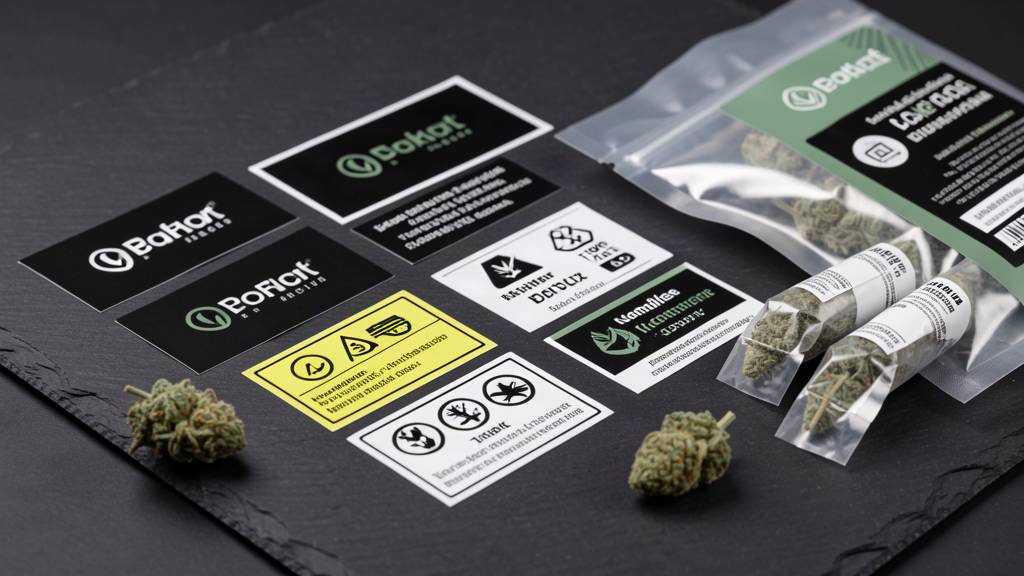
Custom cannabis labels and compliance stickers are required on every cannabis product sold in every legal U.S. state. The average state requires 16.7 separate label elements — ranging from THC potency to batch numbers to universal warning symbols — with some states requiring up to 26 distinct attributes. Getting a label wrong means failed compliance checks, product recalls, and potentially losing your license.
I've spent about 20 years working in marketing and media connected to the cannabis industry. I created Growing Exposed on YouTube — we've built an audience of over 130,000 subscribers and 12.5 million views. I've also written for High Times and Stoner Magazine, and I own LG Digital Inc. So when brands ask me about cannabis labeling, I've seen enough product launches — and enough label-related recalls — to give them a straight answer.
Here's everything you need to know about custom cannabis labels and compliance stickers: what's required, how requirements vary by state, how universal symbols work, what materials and adhesives to choose, and what you should actually be paying at wholesale volumes.
What Are Custom Cannabis Labels and Compliance Stickers?
Custom cannabis labels are the printed labels applied to cannabis product packaging — mylar bags, pre-roll tubes, glass jars, vape cartridge boxes, and any other retail container. They carry your brand artwork on the front (primary panel) and required regulatory information on the back or side (informational panel).
Compliance stickers are a specific subset of cannabis labels. They're pre-printed stickers that carry mandatory information: universal warning symbols, THC/CBD potency values, batch numbers, government warning statements, and state-specific required text. Some brands print compliance information directly onto their packaging during manufacturing. Others apply compliance stickers after the fact, especially when regulations change mid-product-cycle.
The distinction matters because regulations change. If your state adds a new required warning or changes the universal symbol format, pre-printed packaging becomes non-compliant overnight. Compliance stickers let you update regulatory text without reprinting your entire packaging inventory. That's why many multi-state operators use a hybrid approach: brand artwork printed directly on the packaging, with compliance information on applied stickers that can be swapped when rules change.
Cannabis Labeling Requirements: What Every State Requires
A 2022 study published in the National Library of Medicine analyzed labeling requirements across 31 U.S. states with legal cannabis programs. The findings: every state requires THC content disclosure and manufacturer contact information. Over 80% of states require batch numbers, health risk warnings, production tracking labels, universal cannabis symbols, CBD content, and child disclaimer warnings. But the specifics vary dramatically.
Here's what most legal states require on cannabis product labels:
- THC and CBD content: Total potency in milligrams or percentage, displayed on the informational panel
- Universal symbol: A state-specific warning symbol indicating THC presence, required in over 90% of legal states
- Batch or lot number: For production tracking and recall management, required in 94% of states
- Manufacturer name and contact: Required in 100% of legal states
- Government warning statement: Health risk and impairment disclaimers, required in 84-94% of states
- Net weight or volume: In both metric and U.S. customary units where applicable
- Date of packaging: Month, day, and year format
- Child warning: "Keep out of reach of children" or equivalent, required in 87% of states
Primary Panel vs. Informational Panel
Cannabis labels are divided into two panels, and the requirements differ for each. California's Department of Cannabis Control defines this clearly, and most states follow a similar framework:
- Primary panel (front of package): Product identity (generic name), net weight in metric and U.S. units, universal symbol, and for edibles, the words "Cannabis-Infused" in bold text larger than the product identity
- Informational panel (back or side): Manufacturer name and contact, date of packaging, government warning statement, batch number, ingredient list, allergens, instructions for use, and any state-specific required text
The universal symbol must be no smaller than 0.5 inches in height in California. For vape cartridges specifically, the symbol cannot be smaller than 0.25 inch by 0.25 inch on the product itself. Check your state's specific sizing requirements — they're not uniform.
State-by-State Labeling Differences That Matter
Labeling requirements aren't the same everywhere. A label that's compliant in Oregon might fail in New York. Here's how key states differ:
| State | Universal Symbol | Font Size Minimum | QR Code Required | Notable Requirements |
|---|---|---|---|---|
| California | Yes — CA-specific, ≥0.5 inch | 6 point minimum | No (UID tag via METRC) | "Cannabis-Infused" bold above product name; Prop 65 warnings; no city/county names unless 100% locally produced |
| New York | Yes — OCM universal symbol | Standard readable size | Yes — links to COA | "This product contains cannabis and THC"; "Do not use if pregnant or nursing"; Poison Center number |
| Michigan | Yes — MI-specific | Standard readable size | No | THC/CBD concentration with ±15% variance allowed; all ingredients listed; allergen alerts |
| Colorado | Yes — diamond with "THC" | Standard readable size | No | Black symbol for edibles, red for other products; "Contains Marijuana" warning |
| Washington | Yes — red hand symbol | Standard readable size | No | "NOT FOR KIDS" text; emergency 1-800 number; sustainability requirements |
| Oregon | Yes — OR-specific | Standard readable size | No (CCTS tracking) | Full ingredient list; potency in mg and percentage; harvest date |
If you're a multi-state operator, this table is your starting point — not your endpoint. Regulations change, and you need to verify current requirements with each state's regulatory body before printing labels. The state-by-state packaging guide covers the broader compliance landscape.
Universal Cannabis Symbols: Why There's No Single Standard
Despite the name "universal symbol," there's no single universal cannabis symbol in the United States. Each state designs its own. California uses a triangle with "CA" and a marijuana leaf. Colorado uses a diamond with "THC." Washington uses a red hand. New York's Office of Cannabis Management has a distinct symbol. Maine requires its universal symbol on the front of all adult-use cannabis packaging.
The National Cannabis Packaging and Labeling Standards Committee recommended a single industry-wide universal symbol — a cannabis leaf and "THC" enclosed in a triangle — but no state has adopted it as their official standard. Until that happens, multi-state brands need to produce state-specific label variants.
Symbol size requirements also vary. California requires the universal symbol to be at least 0.5 inches tall on the primary panel. Arkansas specifies exactly 0.48 inches wide by 0.35 inches high. Guam requires at least 0.75 inches. These aren't suggestions — they're pass/fail compliance criteria.
Label Materials and Adhesives: What Actually Works
The material your cannabis labels are printed on matters more than most brands realize. A label that smears, fades, or peels off in a dispensary display isn't compliant — and it makes your brand look cheap.
Label Materials
The three most common materials for cannabis labels are:
- BOPP (biaxially oriented polypropylene): The most popular choice. Waterproof, oil-resistant, tear-resistant, and works with matte, gloss, or soft-touch finishes. Ideal for mylar bags and product containers that may be refrigerated or handled frequently.
- Paper labels: Lower cost but less durable. Fine for dry products with short shelf life. Not suitable for products that may be refrigerated or exposed to moisture. Some states' sustainability requirements push toward paper or recycled materials.
- Vinyl: Higher durability and weather resistance. Used for larger containers and outdoor-display products. More expensive than BOPP but lasts longer.
Adhesives
The adhesive on your label needs to match the storage conditions of your product:
- Permanent adhesive: Standard for most cannabis products. Once applied, the label stays put. Required for compliance stickers — you don't want a batch number label falling off.
- Removable adhesive: Used for temporary labels or when the container will be reused. Not suitable for compliance information.
- Freezer-grade adhesive: For products stored in freezers or refrigerators. Standard adhesives fail at low temperatures — the label curls and peels.
For concentrate and edible products that may be refrigerated, specify freezer-grade adhesive when ordering. A label that peels off in cold storage isn't just a branding problem — it's a compliance failure if required information becomes illegible.
Custom Printing: Branding vs. Compliance
When you order custom cannabis labels, you're really ordering two things: brand artwork and compliance text. The best approach is to separate them.
Print your brand artwork — logo, strain name, design elements, brand colors — directly on the packaging or on a full-wrap label. Then apply compliance stickers for the regulatory information: potency values, batch numbers, universal symbols, government warnings. This way, when regulations change, you swap the compliance stickers without reprinting your branded packaging.
For brands ordering custom cannabis labels at wholesale volumes (10,000+ units), full-color CMYK printing on BOPP with a matte or gloss finish runs $0.02 to $0.08 per label depending on size, material, and finish. Compliance stickers — smaller, simpler, often 1-2 colors — run $0.01 to $0.03 per sticker at the same volumes.
How Much Do Custom Cannabis Labels Cost Wholesale?
Label pricing depends on material, size, print complexity, finish, order volume, and whether you're ordering full-wrap custom labels or compliance-only stickers. Here's what you should expect at wholesale volumes:
| Label Type | 10K Units | 25K Units | 50K+ Units | Notes |
|---|---|---|---|---|
| Compliance stickers (1-2 color) | $0.03-$0.05 | $0.02-$0.03 | $0.01-$0.02 | Universal symbol, potency, batch — pre-printed or custom |
| Full-color BOPP (matte/gloss) | $0.05-$0.08 | $0.04-$0.06 | $0.02-$0.04 | Brand artwork + compliance text combined |
| Soft-touch / spot UV finish | $0.08-$0.12 | $0.06-$0.09 | $0.04-$0.07 | Premium feel for higher-end brands |
| Vinyl labels (durable) | $0.08-$0.15 | $0.06-$0.10 | $0.04-$0.08 | Larger containers, outdoor display |
| Custom die-cut shapes | $0.10-$0.20 | $0.08-$0.15 | $0.05-$0.10 | Unique shapes add tooling cost |
Factory-direct suppliers like CropPak typically offer 30-50% lower pricing than broker resellers for equivalent label products. The key is ordering at volume — under 5,000 units, per-label costs can double or triple because setup and tooling costs are amortized across fewer units.
Label Compliance Pitfalls to Avoid
I've seen brands make the same labeling mistakes over and over. Here are the ones that get products recalled:
- Missing universal symbol: Every state requires it, and it must meet specific size and color requirements. A symbol that's too small or the wrong color fails compliance.
- Potency values don't match the COA: Your label's THC/CBD values must match the certificate of analysis. If your batch tests at 22.4% THC and your label says 24%, that's a compliance violation. Some states allow ±15% variance, but check before printing.
- Wrong font size: California requires 6 point minimum font. Some states require specific font sizes for warnings. Generic "readable" isn't enough if the regulator measures.
- Missing batch number: Required in 94% of states. Without it, you can't track product for recalls. This is a basic traceability requirement.
- Non-durable ink: If your label text smears when wet, it's not compliant. Compliance information must remain legible throughout the product's shelf life. This is why BOPP with overprint varnish or lamination is the standard.
- Attractive to children: California and most states prohibit labels with cartoons, candy-like designs, or imagery appealing to children. No "gummy bear" art on your edibles label.
How to Order Compliant Custom Cannabis Labels
When you're ready to order custom cannabis labels, here's the process that actually works:
- Identify your state requirements. Check your state's cannabis regulatory body for the current labeling checklist. California publishes its checklist through the Department of Cannabis Control. New York's Office of Cannabis Management publishes Part 128 guidance. Don't assume last year's rules still apply.
- Specify label dimensions. Measure your container with calipers. Account for any curvature on jars or tubes. A label that's too wide for a curved surface will wrinkle at the edges.
- Choose material based on storage. BOPP for most products. Freezer-grade adhesive for refrigerated products. Paper only for dry, short-shelf-life products.
- Design primary and informational panels separately. Brand artwork on the primary panel, compliance text on the informational panel. Keep them separate so you can update one without reprinting the other.
- Order compliance stickers for variable data. Batch numbers, potency values, and dates change per production run. Print these on separate stickers rather than hard-printing them on the packaging.
- Request a compliance proof. Before full production, have your label reviewed against your state's current requirements. A good supplier will flag missing elements before you print 50,000 labels.
For a full breakdown of what to specify when ordering, the cannabis packaging requirements guide covers the compliance side. For product-specific labeling, our cannabis labeling requirements guide walks through each state's current rules.
Child-Resistant Packaging and Labeling
Child-resistant packaging under 16 CFR 1700.20 is separate from labeling requirements, but they interact. The CPSC testing protocol requires 200 children aged 42-51 months to attempt opening the package, with at least 85% failing. The label itself doesn't need to be child-resistant — the container does. But your label must not obstruct the CR mechanism.
If you're using a CR zipper on a mylar bag, the label can't cover the zipper seal. If you're using a push-and-turn closure on a jar, the label can't interfere with the lid. This seems obvious, but I've seen brands print full-wrap labels that covered the CR mechanism on pre-roll tubes. The package failed certification because the label prevented the CR closure from working properly.
The ASTM D3475 standard covers child-resistant packaging testing methodology and is the protocol most testing labs use alongside 16 CFR 1700.20. Your supplier should be able to provide test documentation for the specific container you're labeling — not a generic compliance claim.
For a deeper dive on CR requirements, read our child-resistant packaging requirements guide.
Future-Proofing Your Cannabis Labels
Regulations change. New York added QR code requirements linking to certificates of analysis. California has updated its universal symbol format multiple times. Sustainability mandates are coming in more states — Washington already has packaging sustainability requirements, and New York is moving in that direction.
The brands that handle this best use a modular labeling system:
- Brand artwork printed on the packaging or on a durable full-wrap label that doesn't change
- Compliance information on applied stickers that can be reordered when rules change
- Potency and batch data on separate stickers applied during production, not pre-printed
- State-specific universal symbols on their own stickers, swapped per market
This approach costs slightly more per unit than printing everything at once, but it saves you from reprinting your entire label inventory every time a state updates its regulations. For multi-state operators, it's the difference between swapping a sticker and dumping 50,000 non-compliant packages.
If you're building a labeling system for the first time or rethinking your current approach, start with our standardized cannabis symbol resources and the compliance hub for current requirements across all legal states.
Frequently asked questions
What information is required on a cannabis label?
Do all states use the same universal cannabis symbol?
How much do custom cannabis labels cost wholesale?
Can I use compliance stickers instead of printing compliance text on my packaging?
What size does the universal cannabis symbol need to be?