Custom Pre-Roll Boxes: Design & Sizing Guide

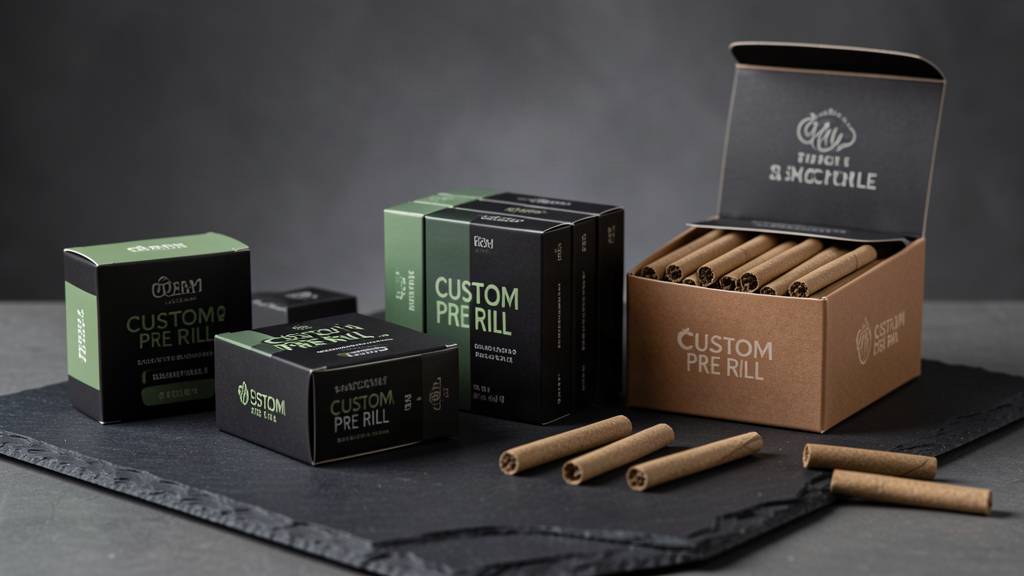
Custom pre-roll boxes are the paperboard or rigid packaging that holds single pre-rolls, multi-packs, and displayed sets on dispensary shelves. They need to fit your product precisely, pass child-resistant certification under 16 CFR 1700.20, and survive shipping without crushing. Get any of those wrong and you're looking at repackaging costs, failed compliance checks, or product that looks bad on the shelf.
I've spent about 20 years working in marketing and media connected to the cannabis industry. I created Growing Exposed on YouTube — we've built an audience of over 130,000 subscribers and 12.5 million views. I've also written for High Times and Stoner Magazine, and I own LG Digital Inc. So when brands ask me about custom pre-roll boxes, I've seen enough product launches — and enough packaging failures — to give them a straight answer.
Here's everything you need to know about custom pre-roll boxes: sizing, materials, compliance, finishes, printing, and what you should actually be paying at wholesale volumes.
What Are Custom Pre-Roll Boxes?
Custom pre-roll boxes are paperboard or rigid cardboard containers designed to hold pre-roll joints for retail sale. Unlike pre-roll tubes, which are cylindrical plastic containers for individual joints, pre-roll boxes are rectangular cartons that can hold a single pre-roll, a multi-pack, or a display set. They're the outer retail packaging that customers see on dispensary shelves.
The key word is "custom." Stock pre-roll boxes exist, but they don't give you branding control. Custom boxes let you specify the exact dimensions, material weight, finish, print colors, and structural design. That matters because pre-rolls come in different lengths and diameters, and a box that doesn't fit your product looks sloppy on the shelf.
You can see our full selection of custom pre-roll boxes or browse all pre-roll packaging options to compare formats.
Pre-Roll Box Sizes: How to Get Dimensions Right
Sizing is the most common thing brands get wrong with custom pre-roll boxes. The box needs to fit your specific pre-roll — not a generic "1-gram pre-roll" — because pre-roll dimensions vary based on the cone paper you use. A 1-gram pre-roll rolled in a 109mm cone is longer and thinner than a 1-gram pre-roll rolled in an 84mm cone. Same weight, different shape.
Standard Pre-Roll Cone Sizes
Pre-roll cones come in standard lengths, and your box needs to match:
- 84mm cones — Typically 0.5g to 0.75g fills. Box needs approximately 3.5 inches internal length.
- 98mm cones — Typically 0.5g to 0.75g fills with a longer, slimmer profile. Box needs approximately 4.0 inches internal length.
- 109mm cones — The standard 1-gram pre-roll. Box needs approximately 4.5 inches internal length.
- 116mm cones — King-size 1g to 1.5g fills. Box needs approximately 4.75 inches internal length.
- 140mm cones — Double-wide or extra-long formats. Box needs approximately 5.75 inches internal length.
Always measure your actual finished pre-roll with calipers before specifying box dimensions. Account for the filter tip, which adds 10-20mm to the total length. Your box interior should be 2-3mm longer than your pre-roll to allow for easy insertion without crushing the cone.
Multi-Pack Box Sizing
Multi-pack boxes hold 2, 3, 5, or 10 pre-rolls in a single carton. These are increasingly popular because they increase average order value and give brands more shelf presence. A standard 5-pack box for 109mm pre-rolls measures roughly 5.0 inches wide by 4.5 inches deep by 1.0 inch tall. A 10-pack display box runs about 7.0 inches wide by 5.0 inches deep by 1.5 inches tall.
For multi-packs, you need interior inserts or dividers to keep pre-rolls from rolling into each other. Without dividers, your pre-rolls shift during shipping, the cones get damaged, and customers open the box to find crushed joints. We've seen it happen with brands that skipped the insert to save $0.03 per unit. Not worth it.
Pre-Roll Box Materials: Paperboard, Kraft, and Rigid
The material you choose for your custom pre-roll boxes affects durability, print quality, cost, and shelf presence. Here's how the three main options compare:
| Material | Thickness | Wholesale Cost | Best For |
|---|---|---|---|
| Folding Carton (Paperboard) | 14-18pt | $0.08-$0.25/unit | Standard retail pre-rolls, 1-3 packs |
| Kraft Cardboard | 16-20pt | $0.10-$0.30/unit | Eco-conscious brands, natural aesthetic |
| Rigid Board | 24-32pt (2-3mm) | $0.30-$0.60/unit | Premium single pre-rolls, gift sets |
| Corrugated (Shipping) | E/B Flute | $0.15-$0.35/unit | Multi-pack display boxes, bulk shipping |
Folding carton paperboard is the most common material for custom pre-roll boxes. It's 14-18pt thick, which is sturdy enough for retail handling but thin enough for clean folding and precise die-cutting. Most single and 2-3 pack pre-roll boxes use 16pt SBS (solid bleached sulfate) paperboard. If you want an eco-friendly look, kraft cardboard uses recycled content and has a natural brown finish that some brands prefer for its organic aesthetic.
Rigid board is thicker (2-3mm) and used for premium packaging — think of a rigid magnetic-closure box like a smartphone box. These cost more ($0.30-$0.60 per unit) but create a premium unboxing experience. Some of the best-selling pre-roll brands use rigid boxes for their flagship strains because the weight and feel communicate quality before the customer even opens it.
Child-Resistant Compliance for Pre-Roll Boxes
Every legal state requires child-resistant packaging for cannabis pre-rolls. The federal standard is 16 CFR 1700.20, which requires packaging to pass a protocol where 200 children aged 42-51 months attempt to open it within 5 minutes — at least 85% must fail. A separate panel of 100 adults aged 50-70 must be able to open and close the package, with 90% succeeding. The CPSC oversees this testing protocol.
Here's how pre-roll boxes handle CR compliance. There are two approaches:
Approach 1: CR-Certified Box
The box itself has a built-in child-resistant mechanism. Common options include push-and-turn closures, slider mechanisms that require two simultaneous actions, or squeeze-and-lift designs. These are tested and certified as a complete unit. The advantage is simplicity — one SKU, one certification. The disadvantage is that CR mechanisms add cost and can be mechanically complex, which means more failure points.
Approach 2: CR Inner Tube + Outer Box
The more common approach is a CR-certified pre-roll tube inside a branded outer box. The tube provides the child-resistant function, and the box provides branding and shelf presence. This is cheaper and easier to update when regulations change, because you can swap the box artwork without re-testing the CR mechanism. Most brands we work with use this approach.
Either way, you need the actual lab test certificate for your specific SKU — not a generic compliance claim. Ask your supplier for the test report from a CPSC-accepted testing lab, dated within the last 2 years, for the exact product you're buying. If they can't produce it, their "CR certified" claim is meaningless. We cover this in more detail in our CR packaging requirements guide.
Per ASTM D3475, the standard classification for child-resistant packaging, your certification must match the specific closure type, material, and dimensions of the product you're shipping. Change any of those and you need re-testing.
Finishes and Printing Options for Custom Pre-Roll Boxes
The finish on your custom pre-roll box is what customers see and feel first. It's the difference between looking like a premium brand and looking like you cut corners. Here are the main options:
- Matte finish — Soft, non-reflective surface. The most popular choice for premium cannabis brands. Runs $0.02-$0.05 per unit extra over gloss.
- Gloss finish — Shiny, reflective surface. Cheaper than matte and makes colors pop, but shows fingerprints and scuff marks more readily.
- Soft-touch (velvet) finish — Textured, velvet-like feel. Premium tactile experience. Adds $0.05-$0.10 per unit.
- Spot UV — Selective glossy coating applied to specific design elements (logo, patterns) on top of a matte background. Creates contrast and draws attention. Adds $0.05-$0.08 per unit.
- Hot foil stamping — Metallic foil (gold, silver, rose gold, holographic) pressed onto the surface. Premium look for luxury brands. Adds $0.08-$0.15 per unit.
- Embossing/debossing — Raised or recessed design elements pressed into the paperboard. Tactile depth without ink. Adds $0.03-$0.06 per unit.
For print colors, most custom pre-roll boxes use CMYK 4-color process printing. If your brand uses specific Pantone spot colors, that requires a separate print plate and adds $0.03-$0.05 per unit. The minimum order quantity for custom-printed pre-roll boxes is typically 5,000 to 10,000 units depending on the supplier.
How Much Do Custom Pre-Roll Boxes Cost?
Wholesale pricing for custom pre-roll boxes depends on order volume, material, finish, and print complexity. Here's what you should expect to pay:
| Box Type | Order Volume | Cost per Unit | Notes |
|---|---|---|---|
| Stock paperboard, no print | 10,000+ | $0.05-$0.12 | Blank, no branding |
| 1-color print, matte finish | 10,000+ | $0.12-$0.22 | Basic branding |
| Full-color print, matte | 10,000+ | $0.18-$0.35 | Standard custom |
| Full-color + spot UV + soft-touch | 10,000+ | $0.30-$0.50 | Premium finishes |
| Rigid box, full custom | 5,000+ | $0.45-$0.80 | Luxury segment |
At 10,000 units, a full-color custom pre-roll box with matte finish runs $0.18 to $0.35 per unit. Add $0.08-$0.15 for premium finishes like spot UV and soft-touch. A CR inner tube adds $0.08-$0.15. So a fully custom, CR-compliant pre-roll box with premium finishes runs about $0.35-$0.65 per unit at 10,000 volume.
Factory-direct suppliers like CropPak typically offer 30-50% lower pricing than broker resellers for equivalent products. A broker who buys from the same factory and adds a 40% markup isn't providing 40% more value — they're just adding a layer of cost. We break down the math in our post on pre-roll tubes vs pre-roll boxes.
Design Tips for Pre-Roll Boxes That Sell
Your pre-roll box is your billboard on a dispensary shelf. Here's what we've learned from working with brands across multiple markets:
Leave 30-40% of your box surface for compliance text. Every legal state requires specific warning labels, potency information, and universal symbols. If you design artwork that fills 100% of the surface, you'll have to shrink or overlay compliance text, which creates a cluttered, unprofessional look. Design your artwork to leave space for the required regulatory information.
Use the front panel for branding, the back for compliance. The front of your box is what the customer sees on the shelf. Put your brand name, strain name, and key visual elements there. The back or side panels are where the state-required warnings, THC content, batch numbers, and government symbols go. This keeps your brand presentation clean while staying compliant.
Consider how the box opens. A bottom-opening tuck-top box is the cheapest but feels generic. A drawer-style slider feels more premium. A magnetic-closure rigid box feels like luxury. Match the opening mechanism to your price point — a $12 pre-roll doesn't need a $0.60 magnetic box, but a $25 premium pre-roll should feel substantial.
Test your box with actual product. Before ordering 10,000 units, get a physical sample. Put your actual pre-rolls inside. Shake the box. Drop it from shelf height. Ship it to yourself. If the pre-rolls rattle, the box dents, or the closure pops open, fix the design before you commit to volume. We offer sample requests through our quote process so you can test before you buy.
Tamper-Evident Features for Pre-Roll Boxes
Most legal states require tamper-evident packaging in addition to child-resistant packaging. Tamper-evident means the packaging shows visible signs if it's been opened before purchase — a broken seal, a torn strip, a perforated tab.
For pre-roll boxes, tamper-evident features include perforated tear strips along the opening edge, breakaway tabs that detach when the box is opened, or shrink band sleeves wrapped around the box. The shrink band approach is the most common because it's cheap ($0.01-$0.02 per unit) and visually obvious — the customer can see the intact band before opening.
Some states also require resealable packaging for multi-pack products, so customers can close the package after taking one pre-roll. If your state requires resealability, design your box with a tuck-top or adhesive closure that survives multiple openings.
Internal vs External Links: Building Your Packaging Strategy
Custom pre-roll boxes don't exist in isolation. They're part of a broader packaging strategy that includes your pre-roll tubes for individual joint protection, your child-resistant packaging for compliance, and your compliance labels for state-mandated warnings. A brand that sources all these components from one factory-direct supplier gets consistent quality, unified lead times, and pricing that's 30-50% lower than buying each component from a different broker.
If you're also packaging flower or concentrates, your pre-roll box design should be visually consistent with your mylar bags and concentrate jars. Shelf consistency builds brand recognition, and dispensaries notice brands that look intentional across their product line.
For multi-state operators, check our state-by-state packaging requirements guide to see how CR and labeling rules vary across markets before you finalize your box design.
How to Order Custom Pre-Roll Boxes
The process for ordering custom pre-roll boxes is straightforward, but skipping steps costs money:
- Measure your pre-rolls. Use calipers to get exact finished dimensions — length, diameter, and filter tip length.
- Choose your box type. Single, 2-pack, 5-pack, or 10-pack display. Tuck-top, slider, or rigid.
- Specify material and finish. 16pt paperboard with matte finish is the standard. Add spot UV or foil for premium positioning.
- Send your artwork. Vector format (AI or PDF) with all fonts outlined. Leave space for compliance labels.
- Request a physical sample. Test it with your actual product before committing to volume.
- Confirm CR certification. Ask for the lab test certificate for your exact SKU.
- Place your order. Typical production time is 10-15 business days for custom-printed boxes at 10,000+ volume.
You can start the process with our quote request form — we'll send you pricing, lead times, and a sample request within one business day.
Frequently asked questions
What size pre-roll box do I need?
Are custom pre-roll boxes required to be child-resistant?
How much do custom pre-roll boxes cost wholesale?
What material is best for custom pre-roll boxes?
Can I get custom-printed pre-roll boxes with my brand logo?