Pre-Roll Tubes vs Pre-Roll Boxes: Which Packaging Is Right for Your Cannabis Brand?

I've spent about 20 years working in marketing and media connected to the cannabis industry. I created Growing Exposed on YouTube — we've built an audience of over 130,000 subscribers and 12.5 million views, making it one of the most-watched cannabis cultivation shows out there. I've also written for High Times and Stoner Magazine, and I own LG Digital Inc. So when brands ask me whether they should be using pre roll tubes or pre-roll boxes, I've seen enough product launches to give them a straight answer.
The short version: it depends on your product, your price point, and how you want customers to experience your brand. Both formats work. They serve different purposes. Let's break down the differences so you can make the right call for your specific situation.
What Are Pre-Roll Tubes?
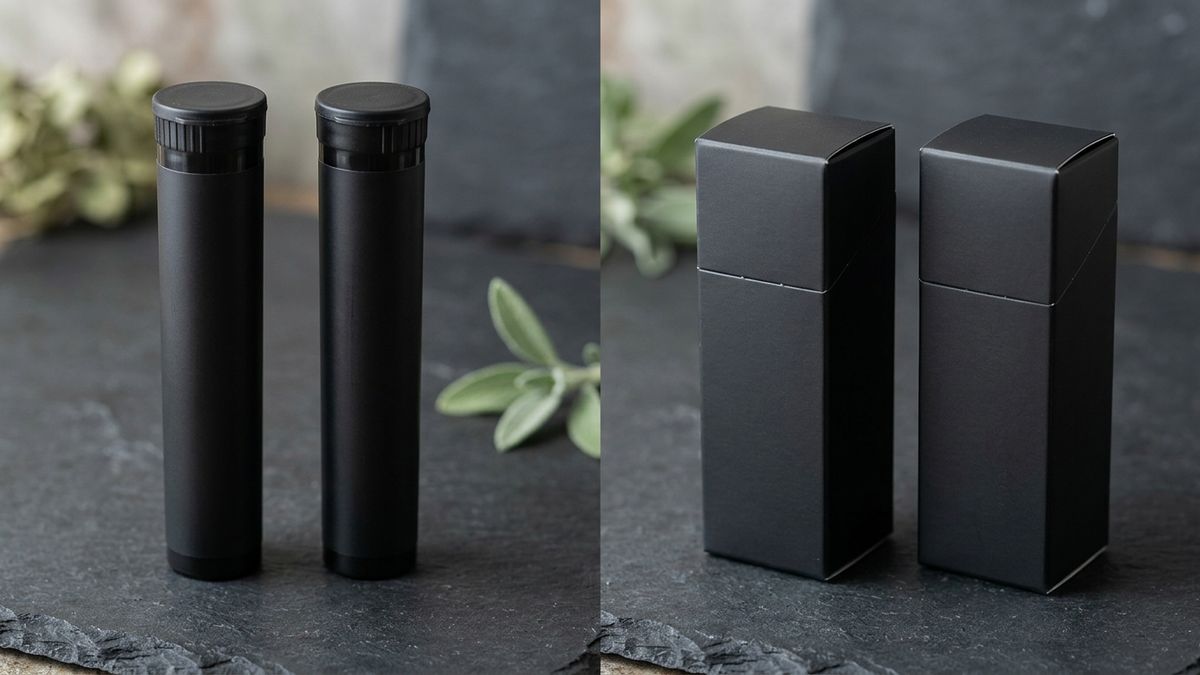
Pre-roll tubes — sometimes called doob tubes — are cylindrical plastic containers designed to hold a single pre-roll joint. They're typically made from polypropylene or polystyrene plastic and come in a range of sizes to match different pre-roll formats.
The two main closure types you'll see are screw-top and pop-top. Screw-top tubes use a push-and-turn mechanism that meets child-resistant requirements under 16 CFR 1700.20. Pop-top tubes use a squeeze-and-pop mechanism where you squeeze the sides of the tube and the cap pops off. These are single-use child-resistant, meaning the CR function works for the initial opening but the tube can be resealed without the CR feature after that first pop.
There's also the cork-top option, which is not child-resistant. If you're selling in any legal state, you'll need a CR option unless you're using the tube purely as an inner package inside a CR outer container. You can browse our full selection of child-resistant pop-top bottles to see the range of CR closure options available.
Pre-roll tubes are the most common single-serve packaging format in North American dispensaries. They're inexpensive, functional, and they protect the pre-roll from damage during transport and handling. For high-volume pre-roll brands, tubes are the workhorse format that keeps per-unit costs down.
What Are Pre-Roll Boxes?
Pre-roll boxes are paperboard or cardboard containers that can hold single or multiple pre-rolls. They range from simple slide boxes holding one joint to multi-packs holding 2, 5, or even 10 pre-rolls in a tray configuration.
Boxes give you significantly more real estate for branding. A tube gives you a curved surface with limited printable area. A box gives you flat panels — front, back, sides, top, bottom — that you can use for full-color artwork, regulatory text, and brand storytelling. If you want to see what's possible with custom box design, check out our custom pre-roll boxes page.
The trade-off is cost and physical protection. A basic tube costs less per unit than a printed box. Tubes also provide better physical protection for the pre-roll itself — the rigid plastic shell prevents crushing and bending. Boxes can be crushed if enough pressure is applied, though a well-constructed box with internal trays mitigates this risk substantially.
Many brands use both formats together: a tube as the inner package for protection and CR compliance, with a box as the outer package for branding and multi-pack presentation. This is the approach premium brands take when they want the unboxing experience to feel substantial.
Pre-Roll Tube Sizes: Getting the Right Fit
This is where a lot of brands make mistakes. Pre-roll tubes come in specific millimeter lengths, and if you buy the wrong size, your pre-roll will rattle around inside (bad for presentation) or won't fit at all (worse). Here are the standard pre-roll tube sizes and what they're designed for:
- 78mm tubes: Designed for mini pre-rolls and slim joints. If you're producing 70mm or shorter mini joints, this is your size.
- 84mm tubes: The standard size for regular pre-rolls with a 7-8mm diameter. If you're rolling standard 1-gram joints in standard cone papers, this is likely your tube.
- 98mm tubes: Made for half-gram pre-rolls and shorter cones. The extra length accommodates pre-rolled cones that are slightly longer than a standard 84mm joint.
- 109-116mm tubes: For standard 1-gram king pre-rolls. These longer tubes accommodate king-size cones and longer joints.
- 114mm tubes: Specifically designed for wide and double-wide pre-rolls. The diameter is larger to accommodate fatter joints.
The diameter matters as much as the length. A standard 84mm tube has an interior diameter of about 7-8mm. If your pre-roll is wider — say you're rolling a double-wide — you need a tube with a wider interior, like the 114mm wide format. Mismatched diameters lead to crushed pre-rolls or tubes that won't close properly.
When you order from a supplier, specify both the length and diameter of your pre-rolls. Don't just say "I need tubes for 1-gram joints" because 1-gram joints come in different lengths and widths depending on the cone paper you use. For more context on how tubes fit into the broader pre-roll packaging landscape, that category page covers all the available formats.
Child-Resistant Compliance: Tubes vs Boxes
Every legal cannabis state requires child-resistant packaging for pre-roll products. The federal standard is 16 CFR 1700.20, and the classification system is ASTM D3475. If you want the full breakdown of what these standards require, read our child-resistant packaging requirements guide.
Here's how tubes and boxes handle CR compliance differently:
Pre-roll tubes
Pre-roll tubes can be manufactured as child-resistant in two ways. The push-and-turn screw-top is the most common CR mechanism — it's the same style used on prescription medication bottles. The pop-top mechanism (squeeze the sides, cap pops off) is also CR-certified for the initial opening. Both meet 16 CFR 1700.20 when properly tested and certified by a CPSC-approved laboratory.
Super Seal tubes are a popular CR tube format that uses a screw-top closure with an integrated seal. They're widely used across North American dispensaries and are accepted in every legal state. The sealed design also helps preserve freshness and prevent odor transfer, which matters for both product quality and customer experience.
Pre-roll boxes
Pre-roll boxes typically achieve CR compliance through a squeeze-and-pull or push-down-and-turn mechanism built into the box structure. Not all boxes are CR — a simple slide-out box is not child-resistant. If you're using a box as your primary consumer-facing packaging, it must have a certified CR closure mechanism.
The critical distinction: a non-CR tube or box can be used as an inner package only if the outer package is CR-certified. So if you use a cork-top tube (non-CR) inside a CR-certified box, you're compliant. If you use a non-CR box with a CR tube inside, you're also generally compliant because the tube provides the CR function. But state rules vary — always check your specific state regulations. Our child-resistant cannabis packaging category includes CR-certified options for both formats.
For a deeper reference on certification testing and documentation, the child-resistant packaging guide walks through the certification process step by step, including how to verify that your supplier's CR claim is legitimate and not just a marketing claim.
Cost Comparison: Tubes vs Boxes at Wholesale
Let's talk numbers. I've seen pricing from enough suppliers to give you a realistic picture of what you should be paying.
Pre-roll tubes at wholesale (10,000+ units)
- Basic screw-top tubes: $0.08 to $0.15 per unit
- Pop-top tubes: $0.10 to $0.18 per unit
- Custom-printed tubes (1-color direct print): $0.15 to $0.25 per unit
- Full-color custom-printed tubes: $0.25 to $0.40 per unit
The doob tubes you see advertised at extremely low prices online are often non-CR cork-top tubes or reject-quality tubes with dimensional inconsistencies. If you're paying less than $0.08 per unit for screw-top CR tubes, ask for the certification documentation. If they can't provide it, walk away. uncertified packaging is a liability that can get your products pulled from shelves or result in state fines.
Pre-roll boxes at wholesale (5,000+ units)
- Basic kraft slide boxes (non-CR): $0.15 to $0.25 per unit
- Printed slide boxes (full color, non-CR): $0.25 to $0.45 per unit
- CR-certified printed boxes: $0.40 to $0.75 per unit
- Premium rigid boxes with inserts: $0.80 to $1.50+ per unit
The key cost difference: tubes are cheaper per unit, especially at volume. But boxes give you branding surface area that tubes can't match. If your retail price point is $8-12 per pre-roll, a tube is usually sufficient. If you're selling premium pre-rolls at $15-25 each or multi-packs at $40-60, the box adds perceived value that justifies the cost.
Factory-direct pricing matters here. CropPak manufactures both tubes and boxes, so you're not paying broker margins. When you compare our pricing to suppliers who resell imported packaging, the difference can be 30-50% on equivalent products. You can request a quote with your specific specs and quantities to get exact factory-direct pricing.
When to Choose Tubes vs Boxes
After about 20 years in cannabis marketing and media, I've seen brands succeed and fail with both formats. Here's my decision framework:
Choose pre-roll tubes when:
- You're selling single pre-rolls at a $8-12 price point
- Your primary distribution is through dispensaries where pre-rolls are displayed in jars or behind the counter
- You need the lowest possible per-unit packaging cost
- Your pre-rolls are standard sizes (84mm or 109mm)
- You're prioritizing physical protection over shelf presence
- You're running high volume (50,000+ units per month) and per-unit cost differences compound quickly
Choose pre-roll boxes when:
- You're selling premium pre-rolls at $15+ per unit
- You're packaging multi-packs (2, 5, or 10 pre-rolls together)
- You need maximum branding surface area for shelf differentiation
- Your brand positioning is premium or lifestyle-oriented
- You're selling in markets where dispensaries display products on open shelves (not behind glass)
- You want the unboxing experience to feel like a product, not a commodity
Use both formats (tube inside box) when:
- You're in a premium segment and want both protection and branding
- Your state requires CR packaging and your box isn't CR-certified
- You're creating a gift set, sample pack, or retail display product
- You want the customer to interact with your brand at multiple touchpoints
The pre-roll tubes vs pre-roll boxes comparison page breaks this down side by side with a detailed spec table if you want to compare dimensions, materials, and pricing in a single view.
Custom Printing and Branding Options
Both tubes and boxes can be custom-printed, but the printing processes and visual results are quite different.
Tube printing
Tube printing is typically done via direct screen print or pad print on the curved surface of the tube. You're limited to 1-3 colors in most cases, and the printable area is a band around the tube — usually about 50-60mm wide. Complex logos with fine detail may not reproduce well on the curved surface.
Some suppliers offer full-color wrap labels applied to the tube, which gives you more design flexibility at a higher cost. These labels can include photographs, gradients, and complex brand artwork that direct printing can't achieve. The trade-off is that labels can peel over time if the tube is handled frequently, and they add cost per unit.
Box printing
Box printing uses offset or digital printing on flat paperboard, which gives you full-color, high-resolution printing across all six panels. You can use spot UV coating, foil stamping, embossing, and specialty finishes that simply aren't possible on a tube. If your brand identity depends on visual sophistication — premium photography, detailed illustrations, or intricate typography — boxes are the better canvas.
For brands ordering custom pre-roll boxes, the minimum order quantity is typically 5,000 units to get reasonable per-unit pricing. For custom-printed tubes, the MOQ is usually 10,000 units. Below those quantities, you're paying setup and plate charges that make per-unit costs prohibitive for most brands.
The Bottom Line
Most cannabis brands don't need to choose one format forever. Start with the format that fits your current product line and price point. If you're launching a single-strain pre-roll at $10, start with tubes. If you're launching a premium infused pre-roll multi-pack at $40, start with boxes. You can always add the other format as your product line expands and your brand evolves.
What matters is that your packaging is CR-certified, properly sized for your product, and consistent with your brand positioning. Don't let a supplier talk you into a more expensive format than you need, and don't cut corners on CR certification to save a few cents per unit. The cost of a compliance failure — product recalls, state fines, damaged brand reputation — dwarfs whatever you saved on packaging.
Ready to get pricing on pre-roll tubes or boxes for your brand? Request a quote with your specs and we'll send you factory-direct pricing — no broker markup, no middleman margins, just straight from our manufacturing line to your operation.
Frequently asked questions
What size pre-roll tube do I need?
Are pre-roll tubes child-resistant?
How much do pre-roll tubes cost wholesale?
What's the difference between pre-roll tubes and pre-roll boxes?
Can I get custom-printed pre-roll tubes?