Health Canada Packaging & Labelling Requirements.
What Canadian cannabis packaging must do - plain packaging, child-resistant, standardized symbol, and more.
Health Canada Packaging & Labelling Requirements
The Canadian Standard
When Canada legalized cannabis on October 17, 2018, Health Canada chose a different path than most US states. Instead of letting brands design whatever packaging they wanted, they mandated plain packaging under the Cannabis Regulations (SOR/2018-144). No brand colours. No imagery. No lifestyle photography. A standardized format with a standardized symbol and strict rules about what goes on every label.
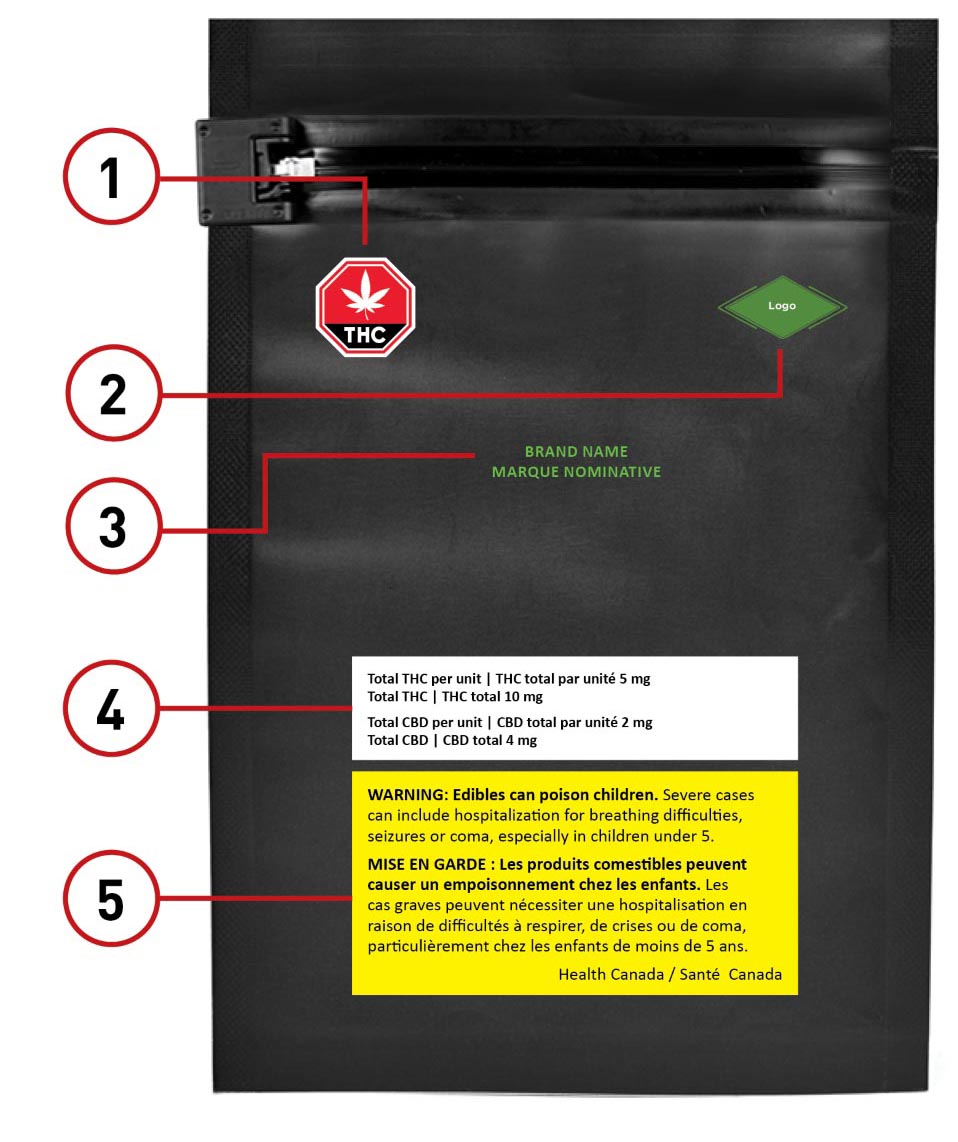
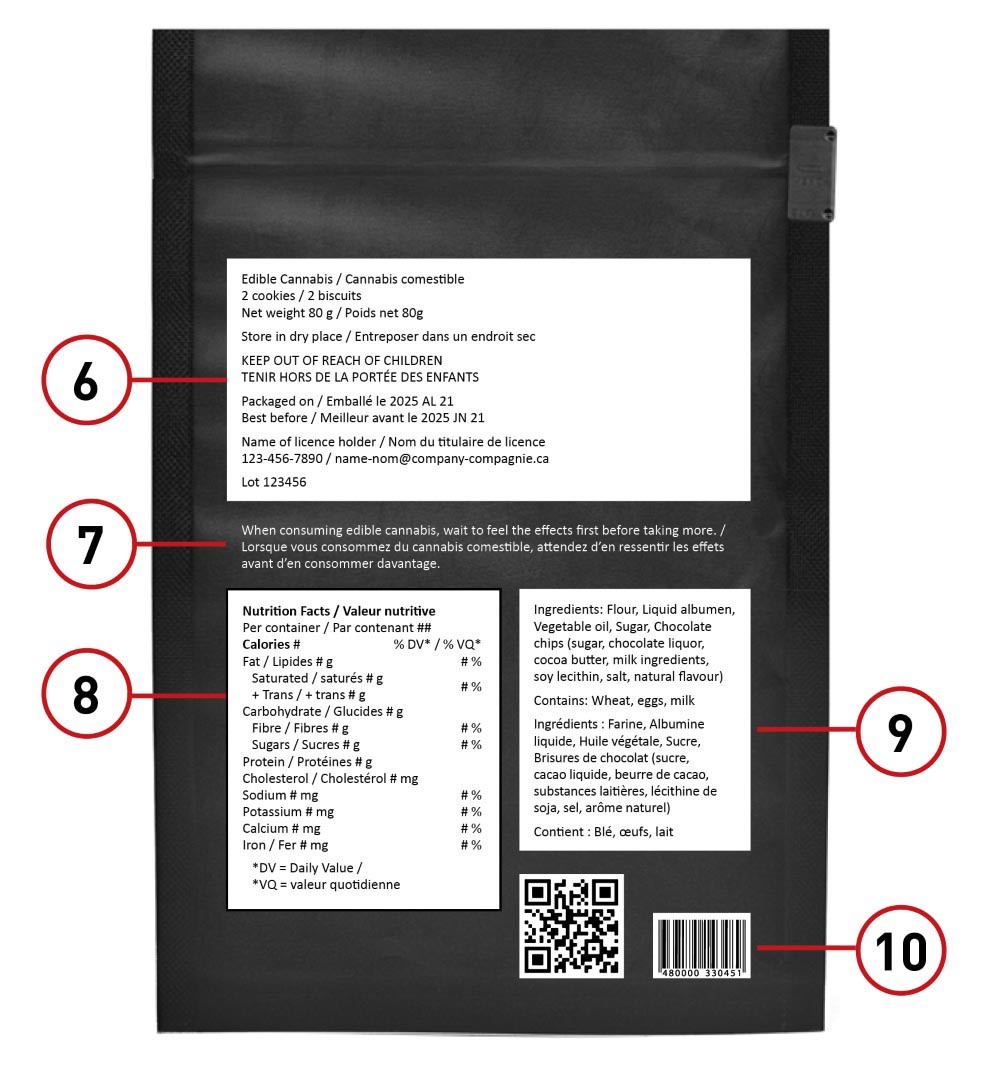
The images below show a compliant Canadian cannabis edible package. Hover over the image to see the back of the package. All 10 mandatory and required elements are numbered on the packaging:
All 10 Required Elements on Canadian Cannabis Packaging
1. Standardized Cannabis Symbol (front, upper-left)
The red octagon with the white cannabis leaf and "THC" text. Mandatory on any product where THC concentration exceeds 10 micrograms per gram (10 µg/g), taking into account the potential to convert THCA into THC. It must be at least 1.27 cm square, placed in the upper-left 25% of the principal display panel, and printed in the exact Health Canada red (Pantone 185, RGB #EB0028) with a white border of at least 2 points.
2. Brand Element (Other Than Brand Name) (front, upper area)
One optional brand element, such as a logo, may appear on the principal display panel in addition to the brand name. It cannot be in metallic or fluorescent colours. If it is an image or graphic, its surface area must be smaller than or equal to the surface area of the standardized cannabis symbol. For products under 10 µg/g THC that don't require the symbol, the brand element image must be smaller than 25% of the principal display panel and smaller than the health warning message area.
3. Brand Name (front, centred)
The brand name must appear on the principal display panel. It cannot be in metallic or fluorescent colours, and its type size must be smaller than or equal to the type size used for the health warning message. The brand name must be bilingual: English and French, with equal prominence. In the example, "BRAND NAME" appears in green capital letters with "MARQUE NOMINATIVE" directly beneath it.
4. Total THC and Total CBD Content (front, centred)
The total THC and CBD content must be displayed in bold type on the principal display panel. The format depends on the class of cannabis and whether it is in discrete units:
- Edible cannabis in discrete units: "Total THC per unit" and "Total THC" (for the entire package), plus "Total CBD per unit" and "Total CBD"
- Dried or fresh cannabis for inhalation: "Total THC" and "Total CBD" expressed in milligrams per gram (mg/g)
- Cannabis extracts: Same as edibles if in discrete units; mg/g if not in discrete units
The values must be in bold, standard sans-serif font, at least 6 points in size, on a white background with at least 6 points of outset on all sides. The THC content on the label cannot exceed 10 mg per unit for edibles, 10 mg per activation for extracts with dispensing devices, and 1000 mg per container for extracts and topicals.
5. Health Warning Message (front, bottom)
A yellow rectangular box containing a bilingual health warning must appear on the principal display panel. The warning system includes six rotating messages that must be displayed in equal numbers over a year of packaging. Each warning has a first sentence in bold type and a second sentence in regular type. Attribution reading "Health Canada / Santé Canada" appears in the bottom-right corner. The yellow background is specified as CMYK C0 M0 Y100 K0 (RGB R255 G242 B0, HTML #FFF100), with a black border of at least 1 point and an inset of at least 6 points on all sides.
6. Other Required Information About the Cannabis Product (back, top)
The exterior display surface (the part visible under normal conditions of purchase) must include several pieces of required product information, all in black text on a white background in a standard sans-serif font at least 6 points in size:
- Class of cannabis: "Edible Cannabis / Cannabis comestible" (or dried, extract, topical, etc.)
- Net weight: In grams, within Health Canada tolerance limits (e.g., "Net weight 80 g")
- Number of discrete units: If applicable (e.g., "2 cookies / 2 biscuits")
- Recommended storage conditions: Temperature, light, or humidity (e.g., "Store in dry place")
- Warning statement: "KEEP OUT OF REACH OF CHILDREN / TENIR HORS DE LA PORTÉE DES ENFANTS" in upper case
- Packaging date: May differ from actual date by up to 7 days (e.g., "Packaged on 2025 AL 21")
- Licence holder contact information: Name, telephone number, and email address
- Lot number: Must be preceded by "Lot number," "Lot no.," "Lot," or "(L)"
- Intended use: For inhalation, ingestion, or topical use (varies by class)
For edibles with a durable life of 90 days or less, a "Best before" date is also required using the bilingual format (e.g., "Best before 2025 JN 21").
7. Non-Required Information About the Cannabis Product (back, middle)
Optional information that is not required by the Regulations may be included on the label, provided it complies with all prohibitions (no appeal to youth, no testimonials, no depictions of people or animals, no association with tobacco or alcohol). This includes cannabinoid information beyond the required THC and CBD totals, consumption warnings, and product descriptions. In the example, a consumption guidance message appears: "When consuming edible cannabis, wait to feel the effects first before taking more." This type of harm reduction information is permitted and commonly included by producers.
8. Nutrition Facts Table (back, middle)
For edible cannabis only, a bilingual Nutrition Facts table is required. It must follow the format set out in Health Canada's Directory of Nutrition Facts Table Formats for Edible Cannabis. The table must display per-container or per-serving values for Calories, Fat (with saturated and trans breakdown), Carbohydrate (with fibre and sugar breakdown), Protein, Cholesterol, Sodium, Potassium, Calcium, and Iron, with % Daily Value columns. The footer must read "*DV = Daily Value / *VQ = valeur quotidienne."
9. List of Ingredients (back, lower)
For cannabis extracts, topicals, and edibles, a bilingual list of ingredients is required. The word "Ingredients" must appear at the beginning of the list without any intervening material. All ingredients must be listed in descending order of proportion. For edibles, food allergen sources must be identified either in the list or in a separate "Contains" statement. The list must be in black text on a white background, in regular weight sans-serif font, at least 6 points in size. In the example: "Ingredients: Flour, Liquid albumen, Vegetable oil, Sugar, Chocolate chips..." followed by "Contains: Wheat, eggs, milk."
10. Bar Codes (back, bottom)
A container may display one or two bar codes, including a QR code, but each must appear only once and must be printed in black and white. Bar codes are not considered brand elements and are exempt from the plain packaging prohibition on images. A QR code may link to additional product information, lab test results, or the licence holder's website. A standard UPC barcode provides retail scanning functionality.
Plain Packaging Rules
The container itself must meet several plain packaging requirements that go beyond what appears on the label:
- Single uniform colour: The interior and exterior surfaces must be one uniform colour. No fluorescent or metallic colours on containers. The colour must contrast with the yellow health warning box and the red cannabis symbol. The lid or cap may be a different colour from the container.
- Smooth texture: No raised features, embossing, or decorative ridges. Does not apply to features needed for opening and closing or to assist visually impaired users.
- No scent or sound: Containers cannot emit either.
- No hidden features: No heat-activated ink or features visible only through technological means (except barcodes or anti-counterfeiting measures).
- No cut-out windows on containers, except for dried cannabis, fresh cannabis, and seeds under strict conditions.
- No brand elements on the container surface, with one exception: a single brand element is allowed on the label.
What This Means for Your Packaging
Every Canadian cannabis order we produce meets all of these requirements. We source the correct child-resistant containers, print the standardized cannabis symbol in the exact specified red, place the health warning in the yellow box with the correct attribution, display THC and CBD content in the correct format for your product class, include all required information in both English and French, and add nutrition facts and ingredient lists for edibles. We are based in Abbotsford, BC, and we ship across Canada every week.
Official source: For the complete and authoritative packaging and labelling requirements, including downloadable specification files and example figures, see the official Health Canada Packaging and Labelling Guide for Cannabis Products. This guide is updated as regulations change. Always consult the current version before finalizing any packaging design.
What we offer
- Plain packaging rules (single uniform colour, smooth texture)
- Standardized cannabis symbol (Pantone 185, 1.27 cm minimum)
- Child-resistant and tamper-evident containers
- THC/CBD potency display (bold, bilingual, class-specific format)
- Health warning messages (yellow box, 6 rotating warnings)
- Bilingual labelling (English and French, equal prominence)
- Nutrition facts table for edibles
- List of ingredients and food allergen sources
- Bar codes and QR codes (black and white, max 2)
- Licence holder contact information and lot numbers
One honest, all-in price.
We work directly with a bench of factories - not as a broker. So we match you to the right one and bring back the best all-in price: packaging, printing, shipping, and any duties or tax - in one number with no middleman and no surprises.
Everything you need to know.
Can I use custom colours on Health Canada cannabis packaging?
What are the bilingual requirements for Canadian cannabis labels?
How is the THC content displayed on Canadian cannabis packaging?
Can I sell US-designed cannabis packaging in Canada?
What is the health warning message and how does rotation work?
Does the container need to be child-resistant?
What information must be on the label besides the symbol and warning?
Can I add my own logo or brand element to Canadian cannabis packaging?
Are nutrition facts required on all Canadian cannabis packaging?
Can I include a QR code on my cannabis packaging?
Where can I find the official Health Canada packaging guide?
What happens if my packaging doesn't meet Health Canada requirements?
Get My Best Price.
One request, direct from the factory. Send us what you need and we'll come back - usually same day.