Dab Containers & Concentrate Jars: The Complete Guide to Cannabis Concentrate Packaging
I've spent about 20 years working in marketing and media connected to the cannabis industry. I created Growing Exposed on YouTube — we've built an audience of over 130,000 subscribers and 12.5 million views. I've also written for High Times and Stoner Magazine, and I own LG Digital Inc. So when concentrate brands ask me about dab containers, I've seen enough product launches — and enough packaging failures — to give them a straight answer.
Here's the thing about dab containers: they look simple. A small jar, a lid, done. But the wrong container will wreck your product. Terpenes evaporate. Concentrate sticks to cheap plastic. Your shatter melts into a blob because the jar wasn't heat-resistant. And if your container isn't child-resistant certified, you can't legally sell it in any dispensary in the country.
Let's break down everything you need to know about dab containers and concentrate jars — materials, sizes, compliance, pricing, and how to choose the right one for your specific product.
Dab Container Materials: Silicone vs Glass vs Plastic
The material you choose for your dab containers matters more than most brands realize. Each material has specific properties that affect how your concentrate behaves inside the container — and how your customer experiences your product.
Silicone Dab Containers
Silicone is the most popular material for dab containers, and for good reason. It's non-stick, which means your concentrate peels off cleanly without leaving residue on the sides. If you've ever tried to scrape shatter out of a glass jar, you understand why non-stick matters.
Silicone containers come in sizes ranging from 2ml up to 100ml, with 5ml, 7ml, and 9ml being the most common for retail cannabis concentrates. A 5ml container typically holds about 0.5 grams of wax or budder. A 7ml holds roughly 1 gram. A 9ml holds about 1.5 to 2 grams. These aren't exact conversions — it depends on your concentrate's density — but they're the standard mappings most brands use.
Silicone is also pliable, which makes it easy to squeeze concentrate out. And it's reusable. Your customer can wash it and use it again. That's a sustainability angle some brands are starting to market.
The downside: silicone doesn't provide an airtight seal the way glass does. If you're packaging a terpene-rich live resin or sauce, you'll lose terpene profile over time in a silicone container. For short-term storage — days to a couple weeks — silicone is fine. For longer shelf life, you want glass with an airtight seal.
Glass Concentrate Jars
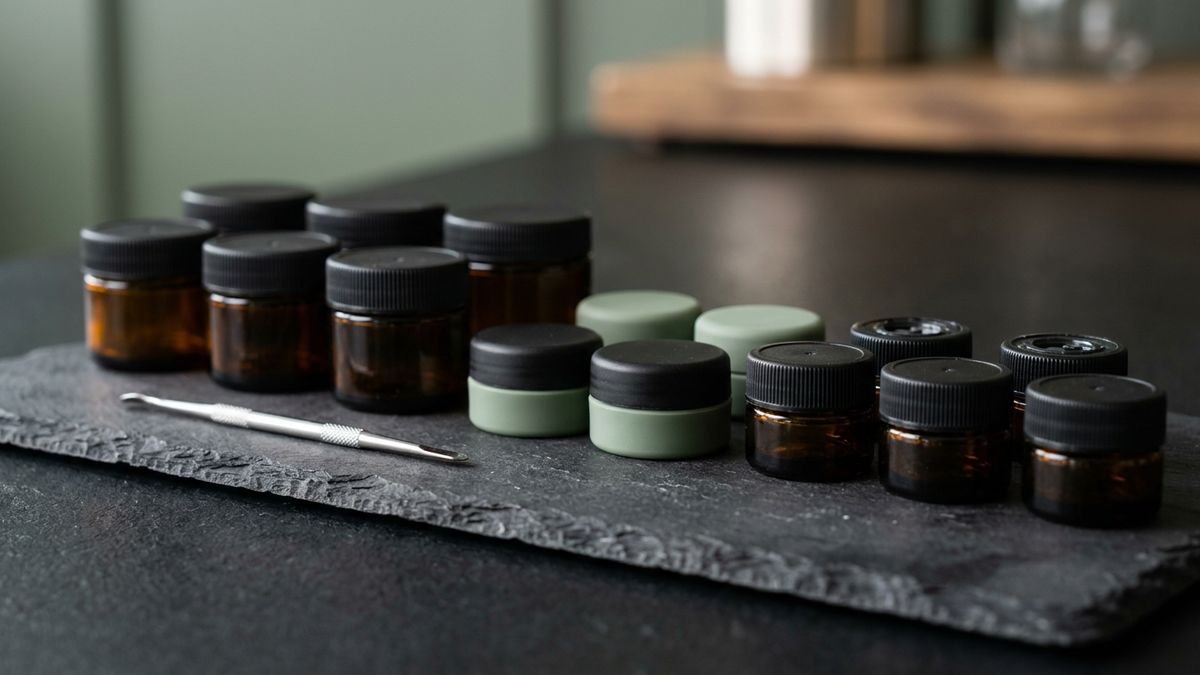
Glass is the premium option. Borosilicate glass jars with airtight silicone or plastic lids preserve terpene profiles better than any other material. They're non-porous, so they don't absorb odors or flavors. They're also recyclable, which matters if you're selling in states like New York that are pushing sustainability requirements.
The most common glass concentrate jar sizes are 5ml, 7ml, 9ml, and 15ml. A 5ml glass jar holds roughly 0.5 to 1 gram depending on the concentrate type. The 7ml is the standard 1-gram jar. The 9ml holds 1.5 to 2 grams, and the 15ml holds about 3 to 4 grams.
Glass jars come in clear, amber, and frosted variants. Amber glass blocks UV light, which matters if your concentrate is photosensitive. If you're selling live resin or any terpene-rich product, amber glass is the better call. Clear glass is fine for shatter and budder that moves quickly off the shelf.
The trade-off with glass is cost and weight. Glass jars cost more than silicone at wholesale — about $0.25 to $0.50 per unit for basic 7ml glass jars versus $0.10 to $0.20 for equivalent silicone containers. But glass communicates premium quality, and your customers will pay more for it. If you're selling a $60 eighth of live rosin, you should not be putting it in a $0.10 silicone pot.
Plastic Dab Containers
Plastic dab containers — typically polypropylene (PP) or polystyrene (PS) — are the budget option. They're lightweight, cheap, and work fine for lower-priced concentrates that move quickly. Polypropylene is FDA-approved for food contact and is recyclable. But plastic doesn't provide the same barrier properties as glass, and it can interact with certain terpene profiles over time.
Plastic containers typically cost $0.08 to $0.15 per unit at wholesale volumes. They're a reasonable choice for budget concentrate lines or for brands that want to keep packaging costs low. But they don't read as premium on a dispensary shelf, and they don't preserve terpenes as well as glass.
Dab Container Sizes: What You Need to Know
Concentrate containers are sold by milliliter volume, not by gram weight. That trips up a lot of new brands. Here's the standard size-to-weight mapping that most cannabis concentrate brands use:
- 2ml: Approximately 0.25 grams of concentrate. Used for sample sizes and single-dose packaging.
- 3ml: Approximately 0.3 to 0.5 grams. Small format, sometimes used for boutique or micro-dose concentrates.
- 5ml: Approximately 0.5 to 1 gram. The most popular size for half-gram retail packaging.
- 7ml: Approximately 1 gram. This is the standard 1-gram dab container — the most common size in the industry.
- 9ml: Approximately 1.5 to 2 grams. Used for 2-gram SKUs and larger concentrates.
- 15ml: Approximately 3 to 4 grams. Used for bulk concentrate packaging.
- 50ml to 100ml: Used for wholesale or bulk concentrate, not typically retail-facing.
The important thing is that these are volumetric measurements. A 7ml jar holds 7 milliliters of volume, but how many grams that translates to depends on the density of your specific concentrate. Wax, shatter, budder, live resin, and sauce all have different densities. A 7ml jar that holds exactly 1 gram of shatter might hold 0.85 grams of a fluffier budder.
When you order from a supplier, specify the ml size you need and test it with your actual product before committing to a full run. I've seen brands order 10,000 units only to discover their concentrate doesn't fit the advertised capacity.
Child-Resistant Requirements for Dab Containers
Every legal state requires child-resistant (CR) packaging for cannabis concentrates. The standard is 16 CFR 1700.20 — the same federal protocol we've covered in our child-resistant packaging guide. If you're selling concentrates in any dispensary in the United States, your dab containers must be CR-certified.
For dab containers, CR compliance typically comes from the lid mechanism. Glass concentrate jars use push-and-turn or squeeze-and-lift lids that meet the 16 CFR 1700.20 protocol. The same testing applies: 200 children aged 42 to 51 months attempt to open the container within 5 minutes, and at least 85% must fail. A separate panel of 100 adults aged 50 to 70 must be able to open and close it, with 90% succeeding.
Some brands use a two-piece system: a non-CR silicone or glass inner container inside a CR-certified outer package. This is compliant because the outer package meets CR requirements. But if your dab container is the only packaging, it must be CR on its own. For more details on how this works across different product types, see our guide on child-resistant packaging options.
ASTM D3475 is another standard you'll see referenced for child-resistant packaging certification. It's the ASTM's version of the same testing protocol and is accepted alongside 16 CFR 1700.20 in most jurisdictions. Ask your supplier which standard their certification is based on. If they can't answer that question, find a different supplier.
Don't assume "CR-certified" means what a supplier says it means. Ask for the actual test documentation — the certificate from an ISO-accredited testing lab, dated for the current SKU. We cover this in detail in our article on child-resistant packaging requirements for cannabis brands.
Custom Dab Containers: Branding and Design Options
Stock dab containers are fine for getting started, but if you're building a concentrate brand, custom packaging is where you differentiate. Here's what you can customize:
Color and Finish
Silicone containers come in virtually any color. You can match your brand's Pantone colors for a consistent look across your product line. Glass jars are available in clear, amber, frosted, cobalt blue, and increasingly in custom-tinted variants. Matte finishes are trending — they read as premium and photograph better for social media.
Custom Printing
Glass concentrate jars can be screen-printed or pad-printed with 1 to 3 colors. For full-color, high-resolution printing, custom labels are typically the better option. Silicone containers can be embossed with a logo — no ink needed, which keeps costs down. Minimum order quantities for custom-printed dab containers typically start at 5,000 to 10,000 units.
Custom Outer Boxes
Many premium concentrate brands use a custom-printed outer box with a CR-certified inner container. This gives you the full surface area of a box for branding while keeping your concentrate protected and compliant. You can pair a 7ml glass jar with a custom-printed carton that carries your brand identity, THC/CBD potency information, compliance warnings, and any state-specific labeling.
If you're going this route, check out our concentrate jars and dab containers page for compatible outer packaging options. And if you're comparing formats, our breakdown of pre-roll tubes vs pre-roll boxes covers similar packaging logic that applies here.
How Much Do Dab Containers Cost at Wholesale?
Pricing varies by material, size, volume, and customization. Here are the typical wholesale ranges I see across the market right now:
- Stock silicone containers: $0.05 to $0.15 per unit (10,000+ units)
- Stock glass concentrate jars: $0.20 to $0.50 per unit (10,000+ units)
- Stock plastic dab containers: $0.08 to $0.15 per unit (10,000+ units)
- Custom-printed silicone (1 color emboss): $0.15 to $0.25 per unit (5,000+ units)
- Custom-printed glass jars (1-2 color screen print): $0.35 to $0.60 per unit (10,000+ units)
- Full custom outer box + inner CR container: $0.60 to $1.20 per unit (10,000+ units)
Here's where it gets interesting. Most of the suppliers you'll find online are brokers — they buy from the same factories CropPak works with and mark up 30 to 50%. When you buy factory-direct, you're getting the same product for less. A 7ml CR glass jar that costs $0.50 from a broker might cost $0.30 from a factory-direct supplier.
On a 50,000-unit order, that's $10,000 in savings. On a 100,000-unit order, it's $20,000. That's not a rounding error — it's the difference between hitting your margin targets and missing them.
Choosing the Right Dab Container for Your Concentrate Type
Different concentrate types interact differently with container materials. Here's a quick breakdown:
Shatter and Pull-and-Snap
Shatter is brittle and can stick to glass, especially if it warms up. Silicone is the go-to for shatter because it flexes — you can peel the shatter off the sides. If you use glass, look for wide-neck jars that give your customer enough room to get a tool in there without scraping the sides.
Wax and Budder
Wax and budder are crumbly and work well in both silicone and glass. Silicone is easier for the consumer to use — squeeze and scoop. Glass looks more premium. If your budder is soft and moist, glass with an airtight lid will preserve the texture better than silicone.
Live Resin and Sauce
Live resin and sauce are terpene-rich and liquid-ish. They need airtight glass with a tight-sealing lid. Silicone won't hold the terpene profile — it'll slowly off-gas through the material over weeks. For premium live resin, use amber glass to block UV light and preserve those terpenes you paid for.
Diamonds and HTFSE
THCA diamonds and high-terpene full-spectrum extracts (HTFSE) are typically packaged in glass — either a small jar or a rectangular vial. The crystal structure of diamonds is best preserved in a rigid container that won't flex. A 5ml or 7ml glass jar with a tight lid is standard.
Crumble and Sugar Wax
Crumble and sugar wax are drier and less sticky than other consistencies. They work well in either silicone or glass. If you're going for shelf presence, glass with a clear window so customers can see the product is a strong move.
Compliance Labeling for Dab Containers
Your dab containers need to carry the same compliance labeling as any other cannabis product. That includes:
- THC/CBD potency in milligrams
- Universal symbol for your state (California uses a triangle with "CA" and a marijuana leaf; New York has its own symbol)
- Net weight in grams
- Batch or lot number for track-and-trace
- Manufacturing date and harvest date if required
- Ingredient list if the concentrate contains any additives
- Warning statements as required by your state
The challenge with dab containers is that they're small. A 5ml jar doesn't give you much surface area for all that text. That's why many brands use a custom label or a custom outer box — it gives you the real estate you need without cramming everything onto a tiny jar lid.
If you're selling in multiple states, you'll need to design modular labeling so you can swap universal symbols and state-specific warnings without redesigning your whole package. We cover this in detail in our state-by-state packaging requirements guide.
Common Mistakes with Dab Containers (And How to Avoid Them)
After 20 years in this industry, I've seen the same mistakes repeat. Here are the ones that cost brands the most money:
Buying non-CR containers and assuming they're fine. They're not. Every legal state requires CR packaging for concentrates. If a dispensary catches you with non-CR containers, they'll reject your product or require you to repackage it. Ask for CR certification before you order — and get it in writing.
Choosing the wrong size. A 7ml jar holds about 1 gram of most concentrates, but if your product is particularly fluffy or particularly dense, you might need a different size. Test before you commit to a volume order.
Using silicone for long-term shelf storage. Silicone is great for short-term use, but it's not airtight. If your concentrate sits on a dispensary shelf for 4 weeks, you'll lose terpene profile. For anything that might sit in inventory longer than a couple weeks, use glass with an airtight seal.
Ignoring UV exposure. Light degrades terpenes and cannabinoids. If your dab container is clear glass and sits under dispensary lighting all day, your product is degrading. Amber or frosted glass mitigates this.
Not planning for multi-state compliance. If you're selling across state lines, you need modular labeling. Designing a single dab container that works everywhere is hard. Designing a base container plus state-specific label sets is much more manageable.
Frequently Asked Questions About Dab Containers
What size dab container do I need for 1 gram of concentrate?
A 7ml dab container is the standard size for 1 gram of most cannabis concentrates. This holds for wax, budder, and shatter. If your concentrate is particularly fluffy — like some crumbles — you might need a 9ml container. For dense products like diamonds, a 5ml or 7ml glass jar works. Always test with your actual product before ordering in volume, because density varies and it affects how the concentrate fits in the container.
Are dab containers child-resistant?
Some are, some aren't. Glass concentrate jars with push-and-turn or squeeze-and-lift lids are typically CR-certified under 16 CFR 1700.20. Stock silicone containers are often not CR unless specifically designed with a CR lid. If you're selling in any legal state, you need CR packaging — either a CR-certified dab container or a non-CR container inside a CR-certified outer package. Ask your supplier for the actual test certificate for the specific SKU you're buying.
What is the difference between silicone and glass dab containers?
Silicone is non-stick, flexible, and cheap — ideal for sticky concentrates like shatter and wax where you want to peel the product off the sides. Glass is airtight, non-porous, and preserves terpene profiles better — ideal for live resin, sauce, and premium concentrates where terpene retention matters. Silicone runs $0.05 to $0.15 per unit wholesale. Glass runs $0.20 to $0.50. Most premium brands use glass for shelf presence and terpene protection; budget brands use silicone for cost savings and ease of use.
How much do dab containers cost wholesale?
At wholesale volumes (10,000+ units), stock silicone containers run $0.05 to $0.15 per unit, stock glass concentrate jars $0.20 to $0.50, and stock plastic containers $0.08 to $0.15. Custom-printed silicone with 1-color emboss runs $0.15 to $0.25. Custom-printed glass jars with screen printing run $0.35 to $0.60. Full custom outer box with inner CR container runs $0.60 to $1.20 per unit. Factory-direct suppliers like CropPak typically offer 30 to 50% lower pricing than broker resellers for equivalent products.
Can I use the same dab container for all concentrate types?
You can, but you shouldn't. Different concentrates interact differently with container materials. Silicone is best for sticky concentrates like shatter and wax because it's non-stick. Glass is best for terpene-rich products like live resin and sauce because it's airtight and preserves terpene profile. For THCA diamonds, rigid glass is preferred because it protects the crystal structure. Using a single container type across all your SKUs means you're compromising on at least one product. Match the container to the concentrate for best results.
Frequently asked questions
What size dab container do I need for 1 gram of concentrate?
Are dab containers child-resistant?
What is the difference between silicone and glass dab containers?
How much do dab containers cost wholesale?
Can I use the same dab container for all concentrate types?